



State Minister for Foreign Affairs Shama Obaed Islam has said that China, Japan, the United States and several other countries are ready to invest in Bangladesh, with discussions already underway on potential investments across multiple sectors.
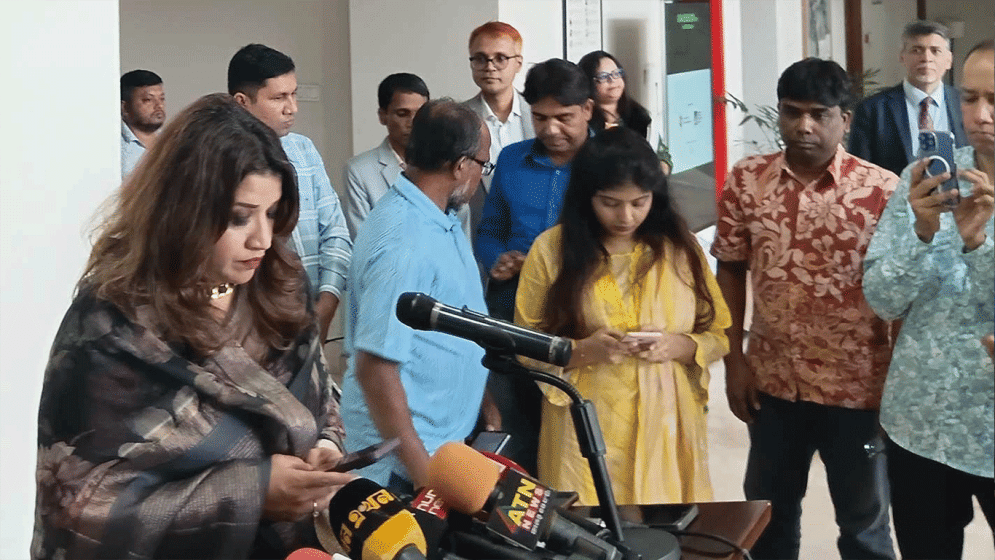
She made the remarks on Sunday after a closed-door dialogue on the Roadmap for Trade, Growth and Economic Diplomacy held at the Ministry of Foreign Affairs in the capital.
Addressing the media after the event, Shama said the dialogue was organised as part of the government’s commitment to strengthening economic diplomacy in line with Prime Minister Tarique Rahman’s election manifesto.
“The participants shared various challenges and recommendations, which we will discuss with the relevant ministries to move toward practical solutions,” she said.
The state minister said the prime minister’s finance and planning adviser is currently working on a range of policy initiatives, including capital market reforms, foreign direct investment (FDI), farmers’ cards, and family cards. Participants at the dialogue had the opportunity to raise questions directly with the adviser on these issues.
Responding to a question about investment challenges, Shama said both foreign investors and expatriate Bangladeshis interested in investing at home face different obstacles.
She said the BNP government had inherited a “crippled economy,” alleging that the banking sector and capital market had been severely damaged over the past 17 years. According to her, the government is now implementing the policies needed to rebuild the economy and transform it into a dynamic growth-oriented system.
Shama said the national budget represents one of the first major steps in that effort. Discussions at the dialogue focused on improving the investment climate, expanding economic zones, and introducing reforms that would make it easier for foreign investors to do business in Bangladesh.
She noted that while the Ministry of Foreign Affairs plays a coordinating role, investment promotion requires close collaboration with ministries responsible for commerce, finance, education, agriculture, social welfare, and other sectors.
Asked about the government’s priority sectors for investment, the state minister identified energy, textiles, the ready-made garment industry, agriculture, and agro-based industries as key areas. She also highlighted the government’s focus on developing the creative economy by encouraging investment in cottage industries, cultural sectors, and marginalised communities.
Shama said sports is another sector with significant investment potential, adding that the foreign ministry is using sports diplomacy to attract investment. The ministry is also working to promote investment in Bangladesh’s cultural industries.
She said the foreign ministry’s primary responsibility is to help realise the prime minister’s vision of transforming Bangladesh into a stronger economy that benefits all citizens, including marginalised communities and women. As part of that effort, the ministry is working with other government agencies to diversify export markets and identify new sources of investment.
The state minister also identified the blue economy as one of the government’s major priorities, saying several European countries have expressed interest in investing in Bangladesh’s maritime economy. She said the government plans to hold more roundtable discussions to identify investment challenges and develop practical solutions.
On the timeline for new investments, Shama said investment is an ongoing process rather than something tied to a specific date.
“Many countries are already in discussions with us about investing in different sectors. Many investors have contacted the Bangladesh Investment Development Authority (BIDA) and are working with both BIDA and the Ministry of Commerce. China, Japan, the United States, and several other countries are ready to invest in Bangladesh, and discussions are continuing,” she said.
Shama added that the government’s long-term objective is to transform Bangladesh into a USD$1 trillion economy, in line with the target announced by the finance minister.
“To achieve that goal, we are working to attract the scale and quality of investment needed. That process is already underway,” she said.