








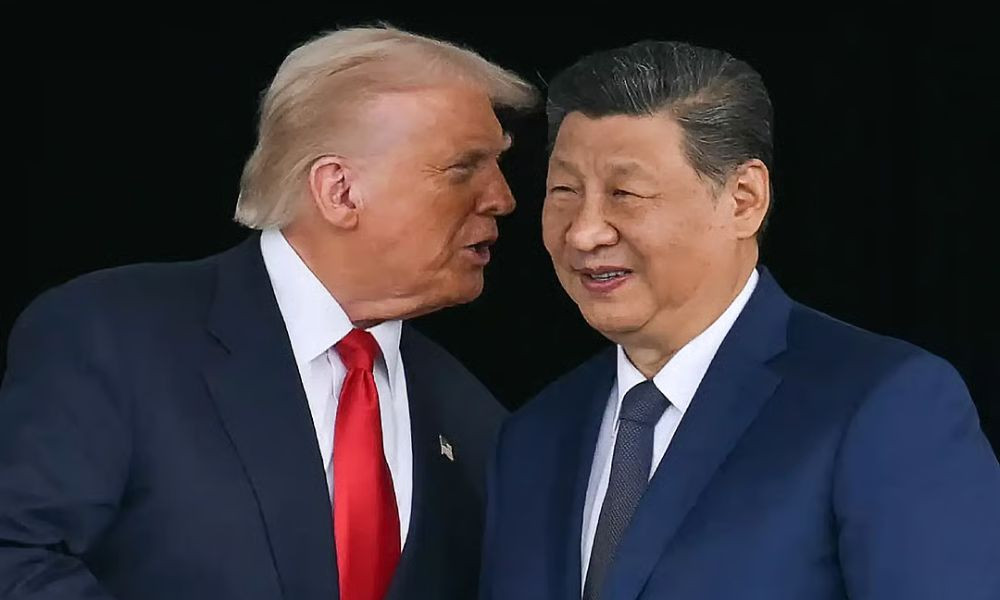

The two leaders held talks in South Korea at the end of October that effectively extended a delicate truce for a year, after several rounds of trade negotiations in recent months.
A statement published Wednesday on the Ministry of Finance website, citing Beijing’s State Council, said that “for one year the 24 percent tariff on US goods will continue to be suspended, (and) a 10 percent tariff on US goods will remain”.
The statement said the pause follows “the consensus reached in the China-US economic and trade consultations” and would be effective from 10 November.
Temperatures have spiked between the world’s two biggest economies this year as Washington and Beijing imposed escalating tariffs on each other’s products.
At one point, duties on both sides reached prohibitive triple-digit levels, hampering trade.
The two have been engaged in an uneasy truce since, as top economic leaders met several times for talks in recent months, with tensions surging over export controls and other issues.
That move was a response to Trump doubling additional tariffs on Chinese goods over Beijing’s handling of fentanyl — now back to 10 percent starting next week.
Beijing had placed an additional 15 percent levy on chicken, wheat, corn and cotton imported from the US and an additional 10 percent tariff on American soybeans, pork, beef, dairy and other farm products.
That had hurt a key source of Trump’s political support: farmers.
Also following talks, Beijing agreed to suspend for one year restrictions on the export of rare earths technology.
Rare earths are a strategic field dominated by China and are essential for manufacturing in defence, automobiles and consumer electronics.
Washington in turn agreed to suspend for one year a move imposing “Entity List” export restrictions on affiliates of blacklisted foreign companies in which they had at least a 50 percent stake, the Chinese commerce ministry said.
The United States also said it would halt for a year measures targeting China’s shipbuilding industry that led to both sides applying port fees against each other’s ships, it said.