



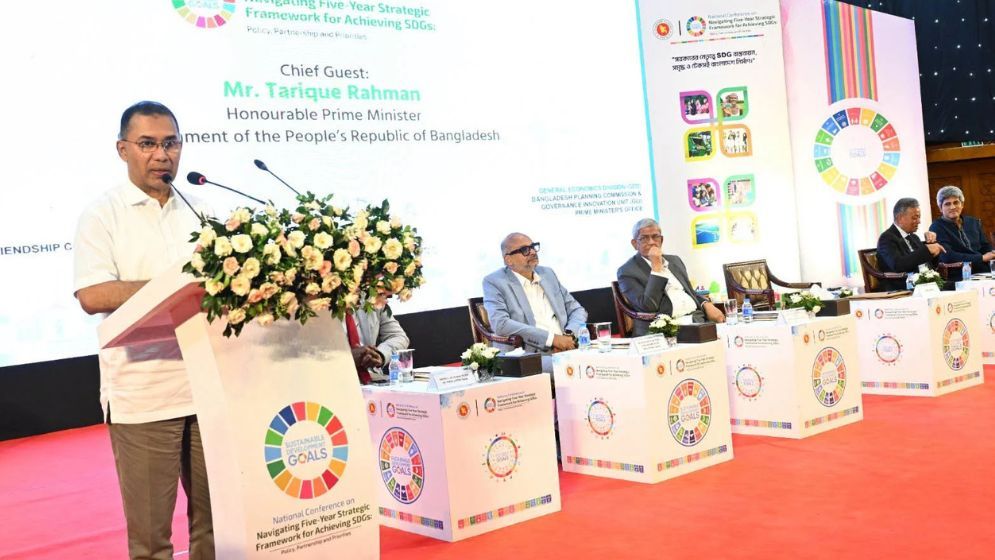

Prime Minister Tarique Rahman said on Monday that it is now time to rebuild Bangladesh, which was turned into a fragile, debt- and import-dependent state during one and a half decades of fascist rule.
Sustainable Development Goals (SDGs) have an undeniable role in the process of rebuilding the country, he said.
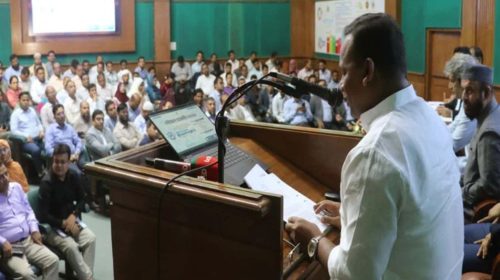
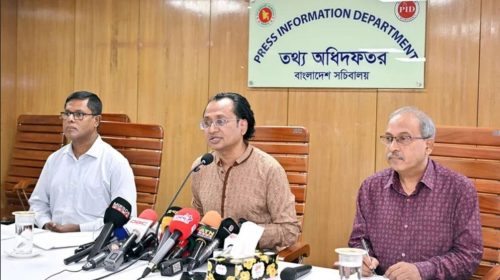
The prime minister was addressing the national conference on “Navigating Five-Year Strategic Framework for Achieving SDGs: Policy, Partnership and Priority 2026” at the Bangladesh-China Friendship Conference Centre in the city.
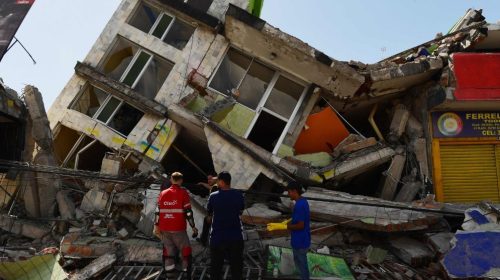
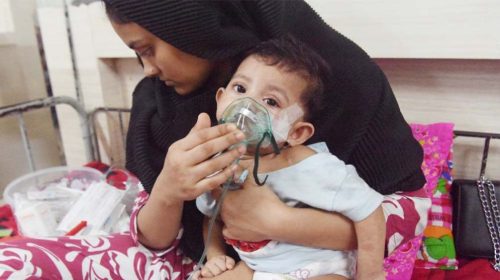
“Exploitation of the fascist for more than one and a half decades has made Bangladesh into a fragile, which now needs to be rebuilt in every sector, including education, health and the environment,” he said.
The General Economics Division of the Bangladesh Planning Commission and the Governance Innovation Unit of the Prime Minister’s Office jointly arranged the conference.
The prime minister said the government has taken initiatives to implement a five-year strategic economic plan aimed at ensuring people’s prosperity, aligning the country’s national development plans with the Sustainable Development Goals (SDGs) adopted by the United Nations.
Referring to BNP’s people-oriented policies, Tarique Rahman said the party’s plans and programmes had always been designed for the welfare of the people.
“There is very little difference between the development agenda of the BNP and the MDGs and the SDGs of the United Nations. Shaheed President Ziaur Rahman’s 19-point charter and ‘Vision 2030’ of former prime minister Begum Khaleda Zia perfectly enshrined the UN-sponsored vision and mission.”
He said Bangladesh had demonstrated its success in implementing the MDGs and was also taking appropriate measures to implement the SDGs.
“You will notice that the SDG principle of ‘No One Left Behind’ is also reflected in the people-oriented policy of the present government,” he said.
“Our government’s policy is ‘Bangladesh for All’ to ensure the interests of people from all walks of life.”
Tarique said his government’s five pillars of reform and development reflected the key priorities of the SDGs, including poverty eradication, universal social protection, quality education and healthcare, gender equality, climate resilience and good governance.
He said the government had adopted a “Three-R” strategy – Recovery, Rehabilitation and Reconstruction – to consolidate the progress achieved in SDG implementation and the country’s graduation from the list of least developed countries (LDCs).
“Under the strategy, everything from temporary stabilisation to long-term structural transformation will be implemented under an integrated roadmap,” he said.
Turning to the government’s initiative for social protection, the prime minister said the government has been implementing various programmes from the day after it assumed office to ensure women’s social and economic empowerment, protect farmers’ interests and make public health and medical services more accessible.
The programmes include the Family Card, Farmer Card and e-Health Card. Through the initiatives, direct subsidies, agricultural inputs, financial assistance and healthcare services are being delivered to marginal farmers, low-income families and vulnerable groups, he said.
He also mentioned the introduction of Sports Card and the inclusion of imams, muezzins and religious leaders of different faiths under honorarium allowances. “In one way or another, the government’s support network is expanding to reach people from every class and profession.”
The prime minister said the government has a well-planned roadmap to gradually bring every citizen under the social safety net and financial assistance coverage during its current tenure.
Tarique said three villages—Mitingachhari in Kaptai upazila of Rangamati, Pankhali in Dacope upazila of Khulna and Nafanagar in Bochaganj upazila of Dinajpur—were selected initially as a pilot project.
He said under the project a range of programmes would be implemented simultaneously in the three villages, including the Family Card, Health Card, Farmer Card, loans for small and medium enterprises, school uniforms, madrasa-based education, renewable energy, village tourism, “One Village, One Product”, tree plantation, canal excavation and ecotourism.
The impact of these initiatives will also be monitored, he said, adding, “Based on the success of the initiative, the government will design a plan to expand the model to other villages across the country.
“I hope the SDG Village initiative will emerge as an exemplary project for presenting the current government’s election pledge to the world as an internationally recognised development model.”
Emphasising the need for coordinated efforts to achieve the SDGs, the prime minister said its successful implementation would require the active participation of all stakeholders, including the government, private sector, development partners, NGOs, civil society, media and citizens.
“I hope that during this three-day conference, each coordinating ministry and department will discuss its progress against targets, challenges and future course of action and adopt realistic and timely action plans and measures.”
He said the government’s vision for the country’s future is clear on several fundamental issues.
“One is a democratic state, where there will be free elections, the rule of law and institutional accountability,” he said.
“Another is a humane state, where healthcare, education and citizens’ rights will be universal. And a welfare state, where economic opportunities for every citizen and intergenerational equity will be ensured,” he added.
The prime minister called upon all to work with firm determination to achieve the Sustainable Development Goals by 2030.
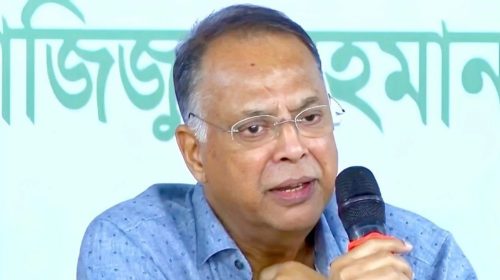
LGRD and Cooperatives Minister Mirza Fakhrul Islam Alamgir, Finance and Planning Minister Amir Khosru Mahmud Chowdhury, State Minister for Planning Zonayed Saki, Planning Division Secretary SM Shakil Akhter and PM’s Adviser for Finance and Planning Rashed Al Mahmud Titumir, among others, were present.