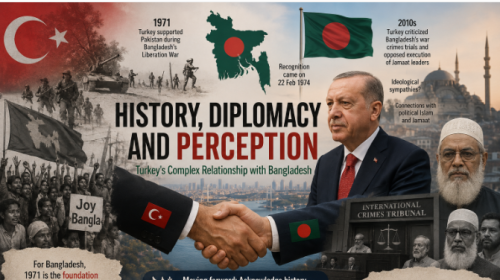








Turkey frequently portrays itself as a defender of justice, democracy, and solidarity across the Muslim world. However, its historical relationship with Bangladesh presents a far more nuanced picture. From supporting Pakistan during Bangladesh’s 1971 Liberation War to criticizing the prosecution of convicted war criminals decades later, Ankara’s policies have often conflicted with the historical memory of many Bangladeshis, for whom the Liberation War remains the cornerstone of national identity.
Turkey’s Position During Bangladesh’s Liberation War
When Bangladesh fought for independence in 1971, Turkey did not support the Bengali nationalist movement. Instead, Ankara maintained its support for Pakistan, treating the conflict as Pakistan’s internal affair and emphasizing the country’s territorial integrity.
Turkey also refrained from recognizing Bangladesh immediately after its victory in December 1971. Diplomatic recognition came only on 22 February 1974, after Pakistan had formally recognized Bangladesh and shortly before Bangladesh’s admission to the Organisation of Islamic Cooperation (OIC).
The delay reflected Turkey’s geopolitical priorities. Pakistan had long been one of Ankara’s closest strategic partners through Cold War alliances and broader cooperation within the Muslim world. Maintaining that relationship took precedence over supporting Bangladesh’s struggle for self-determination.
Bangladesh’s Admission to the OIC
Turkey was not among the leading advocates for Bangladesh’s recognition within the OIC. Instead, it accepted Bangladesh’s membership after Pakistan altered its own position.
The breakthrough resulted primarily from Pakistan’s recognition of Bangladesh, supported by wider diplomatic efforts among Muslim-majority countries. Turkey joined the emerging consensus rather than leading it.
For many Bangladeshis, this distinction remains historically significant. Nations that actively supported Bangladesh during its Liberation War continue to occupy a special place in the country’s collective memory, unlike those that delayed recognition until changing geopolitical realities made it politically expedient.
Jamaat-e-Islami and the Liberation War
During the Liberation War, Bangladesh Jamaat-e-Islami opposed independence and aligned itself politically with Pakistan. Several of its senior leaders were later prosecuted and convicted by Bangladeshi courts for crimes committed during the conflict.
There is no conclusive historical evidence that Turkey specifically endorsed Jamaat-e-Islami in 1971. However, by supporting Pakistan’s position throughout the conflict, Turkey objectively found itself on the same side of the political divide as Jamaat.
Erdoğan’s Government and the War Crimes Trials
Turkey’s relationship with Bangladesh entered a new phase under President Recep Tayyip Erdoğan.
Beginning in the early 2010s, Ankara repeatedly criticized Bangladesh’s International Crimes Tribunal and opposed the execution of several Jamaat leaders convicted of war crimes. Turkish officials described the proceedings as politically motivated and urged clemency.
The Bangladeshi government, however, consistently maintained that the trials represented long-delayed justice for atrocities committed during the Liberation War and were conducted through the country’s judicial process.
Political Islam, the Muslim Brotherhood, and Jamaat
Under Erdoğan, Turkey’s Justice and Development Party (AKP) has generally maintained close political relationships with movements associated with political Islam, particularly those influenced by the Muslim Brotherhood.
Bangladesh Jamaat-e-Islami and the Muslim Brotherhood are distinct organizations with separate historical origins. Jamaat draws much of its ideological inspiration from Abul A’la Maududi, while the Muslim Brotherhood was founded in Egypt by Hassan al-Banna.
Despite these differences, scholars frequently identify several ideological similarities, including:
- the integration of religion and politics;
- advocacy for governance guided by Islamic principles;
- emphasis on grassroots social mobilization; and
- cooperation among Islamist political movements across national borders.
These shared characteristics have contributed to cordial political ties between figures within Turkey’s governing establishment and individuals associated with Jamaat.
The Debate Surrounding Bangladesh’s 2026 Election
Turkey’s posture toward Bangladesh’s 2026 political environment has also attracted public discussion.
Although Ankara has maintained diplomatic engagement with multiple political stakeholders in Bangladesh, some observers argue that certain public statements and diplomatic interactions have been perceived as comparatively favorable toward Islamist political groups, particularly Jamaat-e-Islami.
At present, however, there is no publicly available evidence demonstrating that the Turkish government provided direct electoral assistance, financial support, or operational backing to Bangladesh Jamaat-e-Islami during the 2026 election.
Some individuals within Bangladesh’s ruling BNP have privately alleged that certain Turkish companies may have assisted Jamaat through social media campaigns and financial support during the pre-election period. These claims, however, remain unverified and have not been substantiated by credible documentary evidence. Consequently, assertions of direct involvement by the Turkish government cannot be presented as established fact.
What can be stated with greater confidence is that Turkey’s longstanding criticism of legal actions taken against Jamaat leaders has contributed to a perception among segments of Bangladeshi society that Ankara maintains political sympathy toward the movement.
Why History Still Matters
Turkey’s relationship with Bangladesh illustrates how historical memory continues to shape contemporary diplomacy.
For Bangladesh, the events of 1971 represent far more than a geopolitical transformation. They constitute the defining chapter of the nation’s identity. Consequently, Turkey’s support for Pakistan during the Liberation War and its later criticism of Bangladesh’s war crimes trials remain sensitive and controversial issues for many Bangladeshis.
At the same time, bilateral relations have expanded considerably in recent years. Bangladesh and Turkey continue to strengthen cooperation in trade, investment, defense, education, humanitarian assistance, and economic development.
The future of this relationship will depend on whether both countries can deepen practical cooperation while acknowledging the historical realities that continue to influence public opinion.
History cannot be rewritten, but it can be honestly acknowledged. Lasting friendship between nations is built not by overlooking difficult chapters of the past, but by confronting them with mutual respect, historical accuracy, and diplomatic maturity.
By ATM Rakibul Bassar
Political Analyst, Critic, and Journalist