







When Pakistan was trying to plug a $3bn financial hole in April, Saudi Arabia swung to the rescue with an emergency bailout that underscored Islamabad’s deep reliance on the House of Saud.
Now, as missiles from Iran-backed Houthi militants rain down on Saudi cities and Saudi-backed forces mount a renewed offensive in Yemen, Riyadh has activated a mutual defence pact, drawing Pakistan into a conflict it spent months trying to avoid — and one that is deeply unpopular at home.
After a missile strike on Saturday killed 13 people and injured hundreds at King Khalid International Airport in Riyadh, Pakistan’s Prime Minister Shehbaz Sharif reaffirmed Islamabad’s “steadfast commitment to Saudi Arabia’s sovereignty, territorial integrity and security”. A separate strike on the facility on Sunday killed a Pakistani national.
Pakistan has long sent troops and military trainers to Saudi Arabia. Islamabad delivered a squadron of fighter jets and pilots to protect Saudi Arabia from Iranian missiles and drones after the April bailout was agreed.
But Islamabad had hoped that its diplomatic capital — built up by mediating a ceasefire between Iran and the US — and deterrence would help it avoid direct involvement in renewed fighting in Yemen.
“Now that the Yemen front has gotten hot, Pakistan is faced with balancing two opposing choices,” said Ejaz Haider, a Lahore-based foreign policy writer. He pointed to Islamabad’s “financial dependence on the Saudi state and remittances from workers” on the one hand, and its desire to “[limit] being dragged into this slug fest in Yemen” on the other.
In recent months, Field Marshal Asim Munir, Pakistan’s de facto leader, has leaned on Iran’s leaders to rein in the Houthis and Shia militias in Iraq that have targeted Saudi Arabia.
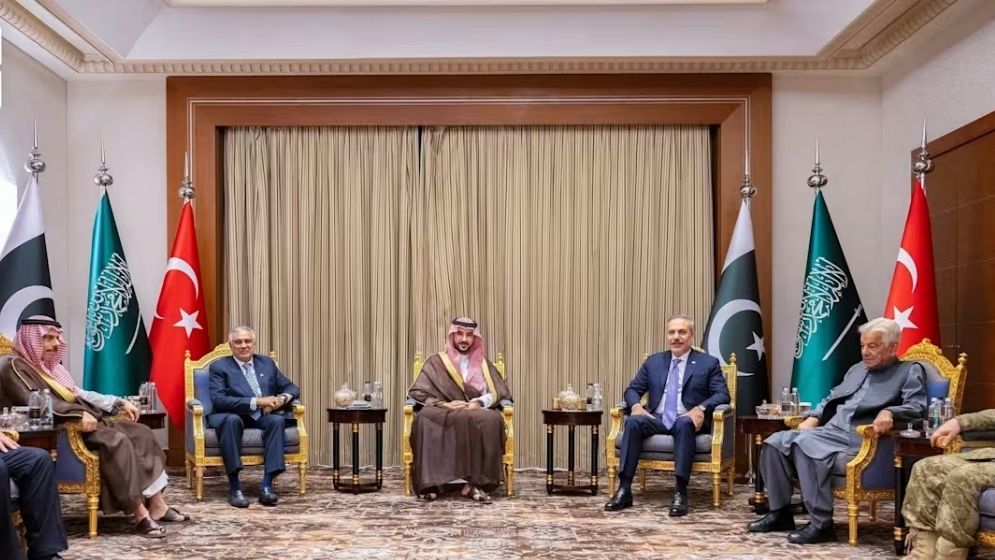
In August, Pakistan renewed its security commitments to Saudi Arabia with the Mecca Joint Defence Agreement, which drew in Turkey, following the signing of a bilateral pact between Islamabad and Riyadh last year.
“Pakistan’s attempts to diplomatically resolve or at least freeze the situation by asking Iran to restrain the Houthis have failed,” said Umer Karim, a researcher on Pakistan-Saudi relations at the University of Birmingham. “Pakistan and Iran are now arrayed against each other in Yemen.”
Last week, the signatories of the Mecca pact announced that Islamabad and Ankara would “provide the agreed military forces and capabilities” to Saudi Arabia after the Houthis resumed targeting Saudi oil installations and tankers and made extensive territorial gains along the Red Sea coast, seizing control of the Bab al-Mandeb Strait, a critical maritime trade route.
Pakistan’s military has vowed that it would “go to any extent” to defend Saudi Arabia and the holy cities of Mecca and Medina.
Pakistani, Turkish and Saudi foreign ministers and other officials in Riyadh in October. The three countries signed a mutual defence agreement in August © Saudi Press Agency/Handout/Reuters
Pakistan has considerable military resources to bear. Its armed forces field more than 660,000 soldiers and 400 fighter and ground-attack aircraft, according to the International Institute for Strategic Studies, including Chinese-Pakistani JF-17s and US-made F-16s. It also produces drones for combat and surveillance, some in collaboration with Turkey.
Islamabad’s forces have been hardened by two decades of counter-insurgency along its restive western frontier as well as skirmishes with arch-enemy India, including a conflict last year in which it claimed to have shot down six of New Delhi’s fighter jets.
But the military’s record on curbing militancy is weak. Insurgents killed more than 1,200 Pakistani security forces last year, the highest death toll in more than 20 years, according to the South Asia Terrorism Portal, a New Delhi-based platform. Violence along the border with Taliban-ruled Afghanistan has also worsened, despite air strikes in recent months.
It is not yet clear the extent of Pakistan’s involvement. A spokesperson for the Saudi-led coalition in Yemen said last week that 100 fighter jets took part in an air campaign against the Houthis. Neither Islamabad nor Ankara has confirmed if their nations’ pilots participated. The Pakistan Armed Forces said it could not confirm or deny any operational details.
One person in Islamabad briefed on the matter said Pakistan had “provided support” to “the joint operation” but did not specify what equipment or personnel were involved.
Yemen’s Iran-backed Houthis have claimed responsibility for a series of attacks on Riyadh’s King Khalid Airport © Social Media via Reuters
But public opposition to outright military involvement in Yemen is widespread.
Much of Pakistan, which includes a large Shia minority, supports the Iranian regime that it sees as standing up to the US and Israel. Thousands mourned when Iran’s former supreme leader Ayatollah Ali Khamenei was killed in late February.
“The people of Pakistan have little appetite to fight a war on behalf of the House of Saud, which would in effect put them on the side of the US and against Iran,” said Haider.
Islamabad has resisted Saudi calls to arms before. In 2015, when Riyadh asked for warships, planes and ground troops in Yemen, Pakistan, led by popular prime minister Nawaz Sharif, demurred. Parliament unanimously passed resolution to “maintain neutrality”.
This time, analysts said, there would be no such public debate. The current government of Shehbaz Sharif, Nawaz’s brother, has a weak base of support and relies on military backing.
The full details of both defence pacts with Saudi Arabia have yet to be made public, and neither document has been presented to parliament for approval.
Pakistan’s options are also constrained by its fragile finances.
Alongside the $3bn emergency loan, Riyadh issued a three-year extension on a $5bn deposit with Islamabad’s central bank — together equivalent to about 38 per cent of its reserves. Migrant labourers in the Gulf kingdom sent home $9.78bn in remittances last year.
Ultimately, said Karim: “Pakistan is in a bind as its commitments towards Saudi Arabia are increasingly pulling it into the war in Yemen which can damage its mediation role [with Iran] and create a degree of additional domestic discontent.”