







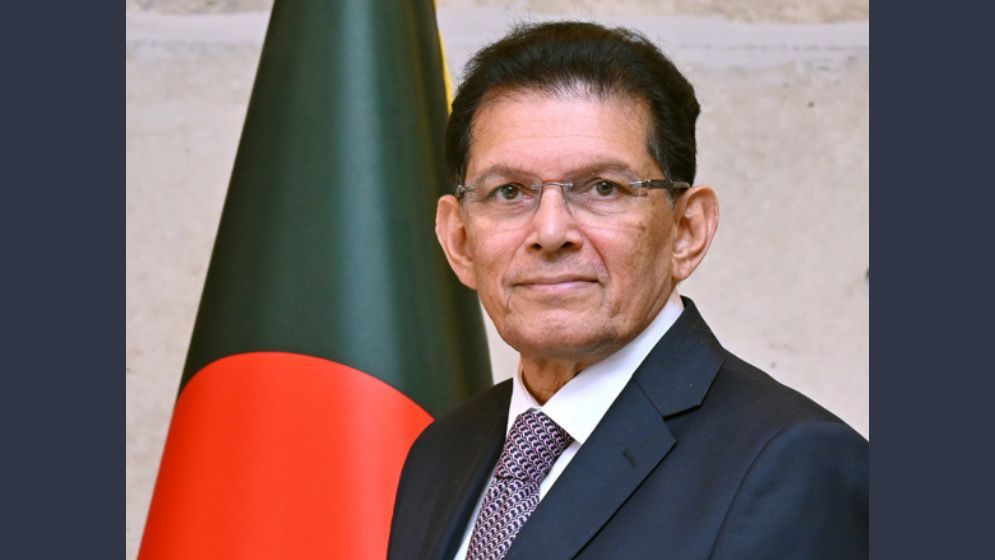

Bangladesh’s election to the presidency of the 81st session of the United Nations General Assembly (UNGA) is a diplomatic achievement that deserves recognition. It provides an opportunity for Bangladesh to project its voice on global issues, including climate change, sustainable development, peacebuilding and the interests of developing countries.
Yet this diplomatic success also raises an important institutional question: can Bangladesh’s foreign minister effectively lead the country’s foreign policy while simultaneously serving as president of the UN General Assembly?
This debate should not be viewed as a question about personalities. It is a question about institutions, accountability and whether the current arrangement best serves Bangladesh’s national interests.
Prime Minister Tarique Rahman has articulated a foreign policy vision centred on national interest, strategic autonomy and balanced engagement with all major partners. The stated objective is for Bangladesh to maintain constructive relations with neighbouring countries and global powers—including India, China and the United States—while ensuring that decisions are guided by Bangladesh’s own priorities.
Such a foreign policy requires strong institutional capacity and sustained political leadership.
The foreign ministry manages some of Bangladesh’s most consequential national interests: bilateral relations, economic diplomacy, regional security, international negotiations, investment promotion, migration, climate diplomacy and the Rohingya crisis. These areas require continuous coordination among the foreign minister, the Prime Minister’s Office, other ministries and Bangladesh’s diplomatic missions abroad.
Foreign Minister Khalilur Rahman has argued that there is historical precedent for combining the two responsibilities. He has referred to former foreign minister Humayun Rasheed Choudhury, who served as president of the General Assembly during its 41st session in 1986-87. Maldives’ Abdulla Shahid also served as foreign minister while holding the UNGA presidency during the 76th session. It is important to note both were career politicians, while Khalilur Rahman is not. At the same time, other recent UNGA presidents have assumed the office after leaving executive government altogether. These differing precedents demonstrate that while dual office-holding is possible, governments have adopted different approaches depending on their domestic circumstances and administrative requirements. They also raise a broader question: whether an arrangement that worked under previous circumstances remains the most effective model in today’s far more complex diplomatic environment.
There is an important distinction between possibility and practicality. The UNGA presidency is a demanding international assignment. The president chairs General Assembly proceedings, facilitates negotiations among 193 member states, represents the Assembly internationally and undertakes extensive diplomatic engagement throughout the year.
At the same time, a foreign minister must provide daily political direction to the country’s diplomatic machinery. Unlike senior officials, a minister carries political responsibility and accountability to the government, parliament and ultimately the public. Effective foreign policy requires not only international visibility but also continuous domestic engagement.
Bangladesh’s current diplomatic challenges make this issue particularly significant.
One important test of foreign policy effectiveness is the country’s relationship with India. Prime Minister Tarique Rahman has emphasised the importance of constructive engagement with neighbouring countries based on Bangladesh’s national interests. The bilateral relationship with India is particularly important because it affects trade, connectivity, water resources, border management, border killings, energy cooperation and regional security.
Progress on these issues requires sustained political attention and regular high-level engagement. Where major bilateral matters require resolution, the public and the parliament are entitled to seek clarity on government priorities, timelines and outcomes.
There has been speculation in certain sections of the media and among higher officials over whether Khalilur Rahman’s personal sentiments regarding India’s reported vote in the UNGA presidential election have affected Bangladesh’s engagement with India. Such claims require evidence before conclusions can be drawn. However, the broader principle remains important: bilateral ties must be managed through long-term national interests rather than short-term perceptions or individual preferences.
A foreign policy based on “Bangladesh First” requires institutional consistency and strategic discipline. Managing relations with India, China, the United States and other partners simultaneously demands clear priorities and continuous political oversight.
This is why the question of institutional arrangements matters.
If the foreign minister spends substantial time fulfilling responsibilities associated with the UNGA presidency, the government should provide clarity regarding how the foreign ministry will function on a day-to-day basis. Who will exercise operational authority? How will key policy decisions be coordinated? How will parliament exercise oversight over a ministry whose political head may spend much of the year abroad?
These are not partisan questions. They are questions of governance.
A strong diplomatic system depends on both political leadership and professional expertise. Bangladesh’s career diplomats have long played an important role in representing national interests abroad. However, diplomats implement policy; political leaders set direction, make strategic choices and remain accountable for outcomes.
The UNGA presidency is an honour for Bangladesh and an opportunity to enhance the country’s international standing. It should be welcomed as a reflection of Bangladesh’s growing diplomatic role.
But international prestige must be balanced with domestic governance needs. The central question is not whether one individual can technically hold two important positions. The question is whether Bangladesh’s national interest is best served when two exceptionally demanding responsibilities are concentrated in one office.
Strong states are built on strong institutions. Clear lines of responsibility, effective delegation and accountability are essential components of successful governance.
As Bangladesh navigates an increasingly complex international environment, its foreign policy institutions must be structured to deliver consistent, focused and accountable leadership. The success of Bangladesh’s diplomacy will depend not only on the prominence of its representatives abroad, but also on the strength of the systems that support them at home.