






The Supreme Court on Thursday restored the non-partisan caretaker government system for overseeing general elections, but ruled that the change will operate only prospectively, meaning it will not apply to the forthcoming 13th parliamentary polls.
The unanimous verdict was delivered by a seven-member full bench of the Appellate Division led by Chief Justice Dr Syed Refaat Ahmed.
The bench included Justice Md Ashfaqul Islam, Justice Zubayer Rahman Chowdhury, Justice Md Rezaul Haque, Justice SM Emdadul Hoque, Justice AKM Asaduzzaman and Justice Farah Mahbub.
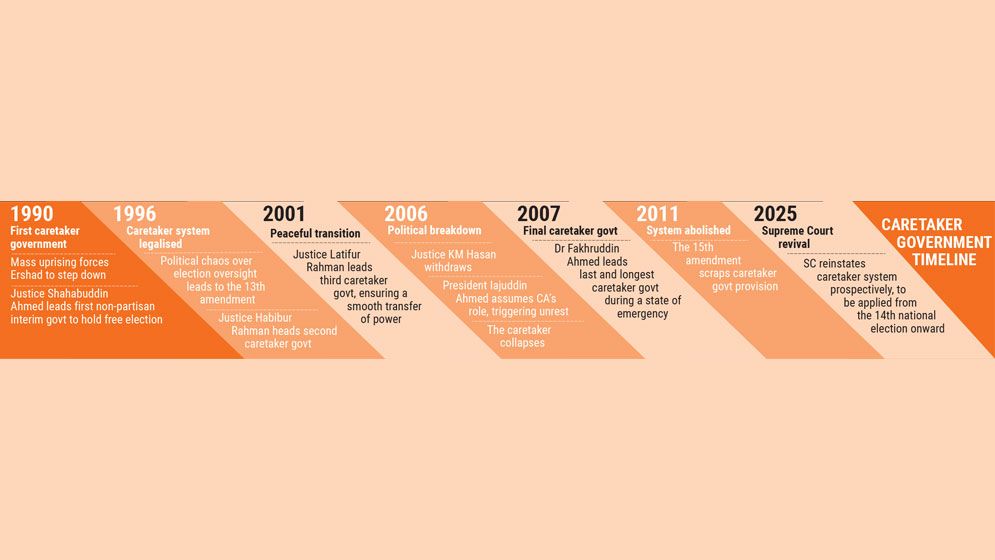
The ruling overturns the Supreme Court’s 2011 decision that struck down the 13th amendment to the constitution, which had institutionalised the caretaker government mechanism.
That earlier verdict had paved the way for the abolition of the system by the then Awami League government.
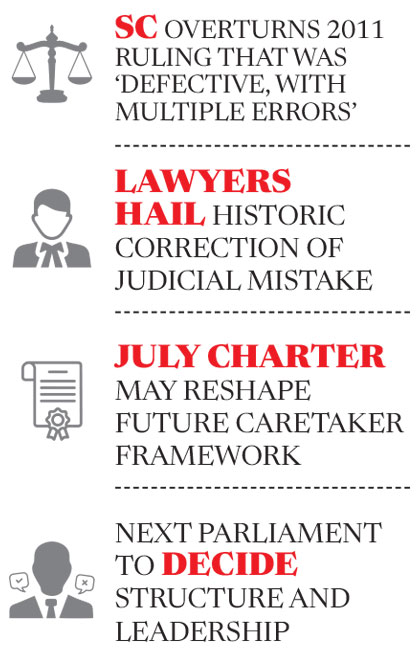
In its judgment, the Appellate Division declared the 2011 ruling to be “defective, with multiple errors” and said it was therefore completely quashed.
The court stated that the neutral interim government system has been “activated and revived”, but clarified that its application will be phased and limited to future parliaments.
The court said the verdict will not affect the forthcoming 13th parliamentary election, as the caretaker model would only come into force after the next parliament completes its term.
Legal and political background
The issue returned to the courts after a High Court verdict struck down parts of the 15th amendment, reopening the debate over whether the caretaker system should be reinstated and how it would function.
The Appellate Division’s ruling now clarifies the system’s return and the timeline for its implementa-tion.
The verdict followed a 10-day hearing on appeals and review petitions filed by the BNP, Bangladesh Jamaat-e-Islami, freedom fighter Mofazzal Islam of Naogaon, and five noted citizens, including Shushashoner Jonno Nagorik (SUJAN) Secretary Dr Badiul Alam Majumder and local government expert Tofail Ahmed.
After the fall of the Awami League government on 5 August 2024, the five citizens first filed a review petition.
Separate petitions were later submitted by the BNP, Jamaat-e-Islami and an individual petitioner. The Appellate Division granted permission for the appeal on 27 August.
Hearings began on 21 October and concluded on 11 November.
Chief Justice of Nepal Prakash Man Singh Raut attended one of the hearing days as an observer.
Advocate Zaiunul Abedin and Barrister Ruhul Quddus Kazal represented the BNP, while Advocate Mohammad Shishir Manir appeared for Jamaat-e-Islami.
Dr Sharif Bhuiyan represented the five citizens, and Advocate Shahriar Kabir argued for the freedom fighter’s petition.
Barrister Ehsan Abdullah Siddiq, Barrister Badruddoza Badal, Advocate Mohsin Rashid and Barrister Shahriar Kabir also spoke as interveners.
Attorney General Md Asaduzzaman and Additional Attorney General Barrister Aneek R Haque represented the state.
Reactions to the verdict
Following the ruling, government lawyers and petitioners expressed satisfaction.
Attorney General Md Asaduzzaman described the decision as a victory for the people’s voting rights, saying the Appellate Division had given the caretaker system a “prospective effect”, meaning it would take effect after the next Parliament.
He added that the full written judgment would further explain how the system supports democratic preservation in Bangladesh. Advocate Zaiunul Abedin said: “As a result of this verdict, the caretaker system has been reinstated. Not only the BNP, but the whole nation is overjoyed.”
Advocate Shishir Manir said the coming election would be held under an interim government, and that the caretaker system would apply from the 14th parliamentary polls, as the non-party government is formed within 15 days of Parliament being dissolved.
Dr Sharif Bhuiyan said the earlier verdict had caused the Supreme Court to suffer a serious loss of public trust and reputation.
“Today, the Appellate Division has properly rectified it, because they have completely annulled the earlier verdict. So, today is a truly historic day for Bangladesh, and also for the Supreme Court,” he said.
He also criticised former chief justice ABM Khairul Haque for his role in the 2011 ruling.
His client, Dr Badiul Alam Majumder, said that the abolition of the caretaker system had led to three successive controversial national elections and that this chapter would now come to an end, reopening the path to fair polls.
July National Charter and unresolved questions
The caretaker system is also referenced in the “July National Charter 2025”, which outlines a detailed framework for governance reform.
Asked whether the Supreme Court verdict would contradict this charter, Advocate Shishir Manir said the current model – where the most recently retired chief justice heads the caretaker government – would not be implemented immediately.
He added that if the charter is passed through referendum and approved in the next Parliament, the structure of the caretaker government could change significantly.
Attorney General Asaduzzaman said the next Parliament would determine the final structure.
On the pending High Court verdict over the 15th Amendment, Shishir Manir said, “Appeals and counter-appeals have been filed and are pending. We need to wait. Otherwise nothing will be fully settled and the debate will continue. We hope it will be resolved soon.”
Historical context
The caretaker government system first emerged during the political transition following the fall of the Ershad regime and was formally incorporated into the Constitution through the 13th amendment by the 6th Parliament on 26 March 1996. That Parliament’s term lasted only 12 days before it was dissolved.
The amendment was challenged in 1998 by three lawyers. While the High Court upheld its legality in 2004, an appeal was lodged in 2005.
On 10 May 2011, the Appellate Division declared the 13th Amendment illegal. In a short verdict, the then full bench led by the then chief justice ABM Khairul Haque stated that the next two general elections could still be held under the caretaker system.
However, his final written verdict, issued on 16 May 2012, excluded that provision.
Justices Md Mozammel Hossain, SK Sinha and Syed Mahmud Hossain supported the altered verdict, while Justices Md Abdul Wahhab Miah and Nazmun Ara Sultana favoured retaining the caretaker system. Justice Md Imman Ali held that the matter should be left to Parliament.
The three judges who supported Khairul Haque were later elevated to chief justice in succession, while those who dissented were not promoted to the top post.
On 24 July 2025, Khairul Haque was arrested in a murder case and later in other cases, including allegations of forgery related to the verdict.