









Environmental activists and experts at a discussion on Sunday said that air pollution in Bangladesh has escalated significantly as the country consistently ranks among the top countries globally in this regard.
The speakers underscored that there is no alternative to curbing air pollution to safeguard public health and protect the country’s environment, stressing that the strong enforcement of the Air Pollution (Control) Rules is crucial to achieving this goal.
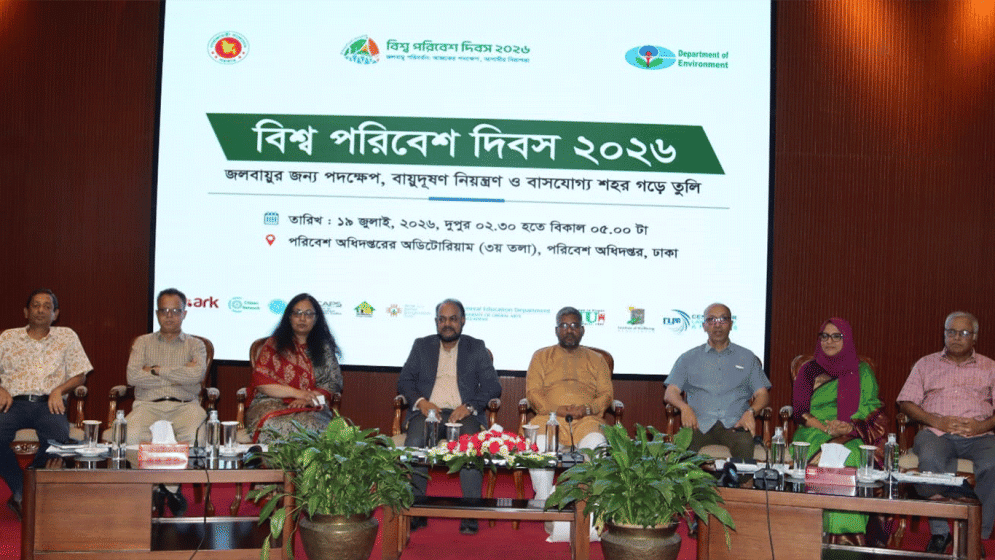
The discussion titled “World Environment Day 2026: Climate Action, Air Pollution Control, and Creating Liveable Cities” was held at the auditorium of the Department of Environment (DoE).
It was jointly organised by the DoE, Center for Law and Policy Affairs (CLPA), Center for Atmospheric Pollution Studies (CAPS), WBB Trust, ULAB, Dhaka International University, Earth Foundation, IWB, ARK Foundation, Grambangla Unnayan Committee and Citizens’ Network (CiNet).
Md Ziaul Haque, additional director general of DoE; attended the event as the chief guest, where Prof Dr Ahmad Kamruzzaman Majumder, dean of the Faculty of Science at Stamford University and chairman of CAPS, along with Naima Akter, project manager at WBB Trust, presented the keynote speeches.
Kamrunnisa Munna, senior policy analyst at CLPA, moderated the event and Aminul Islam Bokul, executive director of Earth Foundation, delivered the welcome address, while Prof Md Akter Mahmud of the Department of Urban and Regional Planning at Jahangirnagar University, Dr Rumana Huq, a professor of Economics at Dhaka University and executive director of ARK Foundation, Syed Mahbubul Alam, secretary of CLPA, and Gaous Pearee, director of WBB Trust, spoke at the event, among others.
The speakers said that 242 people die daily across six major cities in Bangladesh for air pollution. However, 48% of the total deaths related to air pollution occur in Dhaka and Chattogram alone, with annual fatalities reaching approximately 68,703 in Dhaka and 11,202 in Chattogram.
Over the past 28 years, the green areas in Dhaka have shrunk by 9%, whereas concrete cover has surged to 82% over the last two decades, leaving water bodies at a meager 2.9%. The pedestrians and non-motorised transport users bear the brunt of this hazardous pollution.
They further said that 8.3% of Bangladesh’s GDP is spent due to air pollution. They urged the government to enhance the efficiency and capacity of various ministries involved in tackling pollution.
Emphasising zero-carbon transportation methods like walking and cycling, the speakers said that while 45% of people globally commute to work or educational institutions by bicycle daily, the figure is nominal in Bangladesh.
They called for the immediate promotion of green infrastructure, the use of building materials with lower heat absorption, and the development of green pedestrian and cycling corridors alongside canals, lakes, and railways.