











Health experts and journalists have called for sustainable financing for hypertension control in Bangladesh, urging the government to prioritise the disease in its increased health budget to reduce preventable deaths from non-communicable diseases (NCDs).
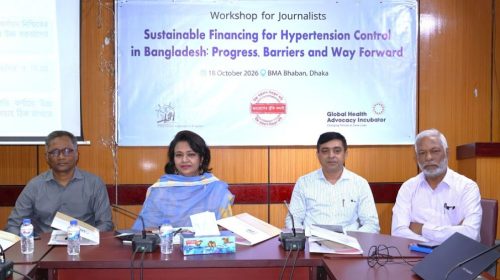
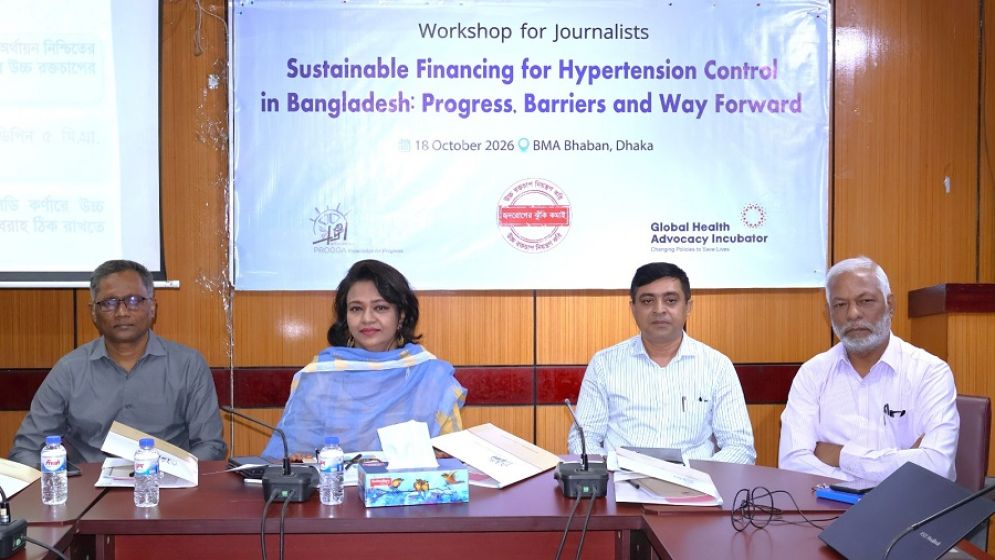
The call was made at a workshop titled “Sustainable Financing for Hypertension Control in Bangladesh: Progress, Barriers and the Way Forward” at BMA Bhaban in Dhaka on Sunday. Research and advocacy organisation PROGGA (Knowledge for Progress) organised the event with support from the Global Health Advocacy Incubator (GHAI), bringing together 28 journalists from print, television and online media.
According to the Bangladesh Bureau of Statistics (BBS) Health and Morbidity Status Survey 2025, hypertension ranks first among the country’s 10 leading diseases. NCDs, including hypertension, cause approximately 571,000 deaths in Bangladesh every year.
Around 283,800 people died from cardiovascular diseases in 2024, with hypertension accounting for 52 per cent of those deaths, participants were told. The condition is also becoming increasingly common among young people, with the Bangladesh NCD STEPS Survey 2018 finding that around 12 per cent of people aged 18–39 had hypertension.
Md Riad Arafin, deputy general manager (sales and marketing) of Essential Drugs Company Limited, said the increased health budget for the 2026–27 fiscal year was an important government initiative.
“Prioritising hypertension control in the increased allocation could ensure an uninterrupted supply of free medicines for marginalised communities,” he said.
Doulot Akter Mala, president of the Economic Reporters’ Forum (ERF), said NCDs account for 71 per cent of all deaths in Bangladesh, while only 4.2 per cent of the health budget is allocated to the sector.
She stressed that the media could play an important role in highlighting the need for increased funding to address the growing burden of NCDs.
Muhammad Ruhul Quddus, Bangladesh country lead at GHAI, said hypertension affected more people in the country than any other disease, making sustainable financing essential to controlling it.
The workshop was chaired by ABM Zubair, executive director of PROGGA, while Samiha Bintay Kamal, programme officer at the organisation, delivered the thematic presentation.


