


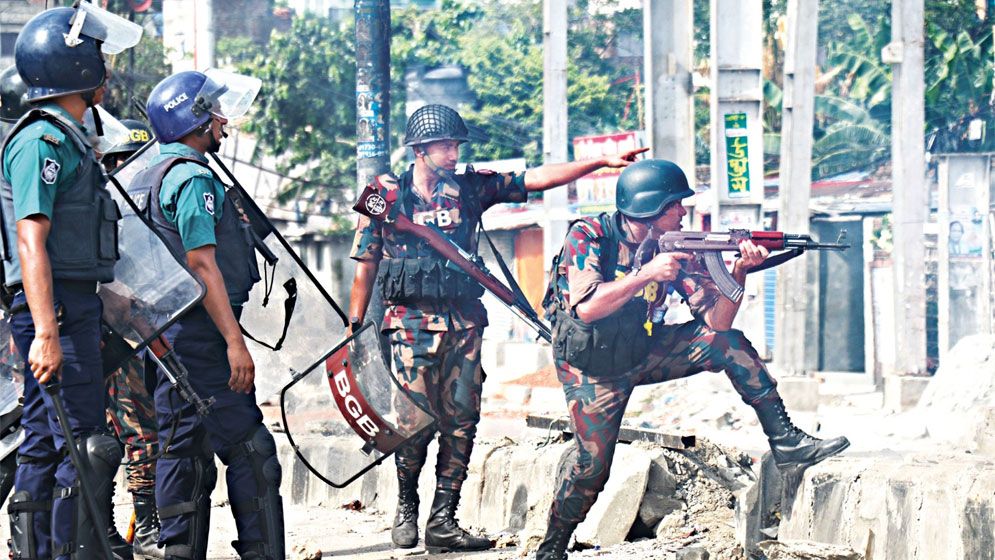

Two years after Bangladesh’s July 2024 mass uprising, key questions surrounding the use of lethal force by law enforcement agencies remain unanswered.
Allegations involving the use of 7.62mm ammunition, sniper rifles, helicopter gunfire, and armed men in civilian clothes have yet to be fully investigated, fueling frustration among survivors and families of victims, BBC Bangla reports.
Although hundreds of people were killed during the movement, there has been no comprehensive national investigation into which forces used helicopters to fire on protesters, what types of weapons were deployed, or whether sniper rifles were used.
Officials at both the Ministry of Home Affairs and the investigation agency of the International Crimes Tribunal (ICT) have acknowledged that, apart from police weapons, they have not been able to identify the weapons, ammunition, or involvement of other security forces.
Survivors demand answers
Walid Islam Nayeem Jamadar, who was active in the Uttara Azampur area during the uprising and was himself wounded by gunfire, expressed disappointment over the lack of investigation.
He said helicopters were deployed during the protests and many deaths were suspected to have resulted from sniper fire, but no credible inquiry has determined what actually happened.
Nayeem questioned why investigators have still not established whether shots were fired from helicopters, where alleged sniper attacks occurred, or which security agencies were responsible.
“There are several law enforcement agencies–Army, RAB, Police, BGB. We still don’t know which force fired at us, whether it was another intelligence agency, or even whether foreign personnel were involved. Everything remains unclear,” he said.
Another protester, private university student Sheikh Nazmus Sakib, who participated in demonstrations in Badda, Rampura, and Banasree, also voiced frustration. He recalled seeing armed men in civilian clothing being evacuated by helicopter and said a fellow protester standing beside him was killed by what he believes may have been sniper fire.
No dedicated government investigation
Officials at the Ministry of Home Affairs said that no separate investigation has been conducted into the alleged use of helicopters, sniper rifles, or weapons carried by unidentified armed individuals.
The issue of 7.62mm ammunition first drew widespread attention when Brig Gen (Retd) M Sakhawat Hossain briefly served as home adviser in Bangladesh’s interim government.
He said his comments about 7.62mm ammunition had been widely misunderstood. According to him, his primary concern was why police had been supplied with such lethal ammunition.
“I saw injured police officers and protesters. One young man had a bullet lodged in his arm that had shattered the bone. After witnessing that, I questioned why this type of ammunition had been issued to the police,” Sakhawat said.
He also questioned how civilians dressed in plain clothes were seen in videos firing prohibited weapons alongside police officers.
“I repeatedly raised the issue in cabinet meetings and with the then home adviser, asking how civilians obtained these rifles. I don’t know whether anyone took the matter seriously,” he added.
Police fired more than 300,000 rounds
Although no separate investigation into the ammunition has been completed, senior home ministry officials confirmed that police had long possessed 7.62mm ammunition. They said investigations into the issue would be conducted as part of the broader prosecution of the July killings.
The cases are currently being prosecuted before the International Crimes Tribunal.
Chief Prosecutor Md Aminul Islam said that investigators have documented the police’s use of lethal weapons, including submachine guns (SMGs), light machine guns (LMGs), Chinese rifles, shotguns, 9mm pistols, and 7.62mm ammunition.
According to the investigation, police fired approximately 305,000 rounds of 7.62mm ammunition nationwide, with nearly 95,000 rounds were fired in Dhaka alone. Lethal weapons were used in around 41 districts.
However, investigators have not yet obtained statistics or weapon inventories from the Army, Border Guard Bangladesh (BGB), or Rapid Action Battalion (RAB).
“Our investigation is ongoing. We are trying to determine what lethal weapons were used by RAB, BGB, and the Army,” Aminul said.
Preliminary evidence suggests sniper use
One of the most controversial issues remains the suspected use of sniper rifles.
Many protesters believe several deaths–including that of Mir Mugdha, who became widely known for distributing water to demonstrators in Uttara–may have resulted from sniper fire after victims were struck by single, highly accurate bullets fired from long distances.
The ICT’s chief prosecutor said preliminary investigations indicate that sniper rifles were likely used.
“There were many incidents where a procession was moving, with nothing around, and suddenly someone was struck by a bullet that entered one side of the body and exited the other, killing the victim instantly. Such killings are consistent with sniper fire,” Aminul said.
He added that investigators have not yet recovered any sniper rifles but believe, based on preliminary evidence, that sniper weapons were used. Investigations are continuing to determine who was responsible.
Former adviser says he was warned about snipers
Sakhawat Hossain said he received an anonymous warning during the August 2024 events informing him that snipers had been deployed.
He also said that after examining two bodies and reviewing X-ray images, he became convinced that the victims had been shot by sniper rifles because of the precision of the wounds.
“I saw two bodies myself. One young man had been shot in the head. The bullet had fragmented inside the skull. Snipers aim at vital organs,” he said.
He claimed he was advised to withdraw from the area because snipers had been deployed and believes many sniper shots were fired on 5 August.
Sakhawat also said some people suspect that not all snipers belonged to Bangladesh’s security forces and that foreign-trained shooters may have been involved. However, he acknowledged that no investigation has confirmed those suspicions.
Police reject sniper allegations
Bangladesh Police Headquarters maintains that the force did not possess sniper rifles before 5 August 2024.
Police said media reports regarding procurement of sniper rifles in 2024 referred to weapons purchased for United Nations peacekeeping missions, which were only delivered in 2025.
The ICT investigation has likewise found no evidence that police possessed or used sniper rifles during the July Uprising.
Nevertheless, Chief Prosecutor Aminul Islam said investigators continue to examine possible sniper activity in Uttara, Jatrabari, and several other locations and hope to produce a conclusive report.
Competing narratives
The absence of a comprehensive investigation has fueled competing narratives regarding the violence.
Leaders of the now-ousted Awami League have argued that unidentified armed individuals or snipers may have been used to provoke violence and intensify the movement, rather than security forces alone being responsible.
Protester Sheikh Nazmus Sakib said the failure to establish the facts has allowed conflicting versions of events to gain traction.
“We are now hearing claims that some other group fired the shots, or that people shot themselves to blame the government. These narratives exist because no proper investigation has been completed,” he said.
Calls for a full inquiry
Sakhawat Hossain believes a comprehensive investigation remains essential.
He said investigators should determine who planned the use of excessive force, who authorised sniper deployment, what ammunition and weapons were used, and how the operations were carried out.
“If these questions are investigated step by step, we will eventually understand what really happened,” he said.
He acknowledged that the interim government failed to conduct such an investigation, citing multiple crises and continuous protests during its tenure, but insisted that the elected government now has a responsibility to complete the inquiry.
“We failed to do it, but that does not mean the current government should also fail. The home ministry must investigate who was responsible for the excessive use of force,” he said.
The Ministry of Home Affairs has not issued an official public statement on the matter.
However, ministry sources told BBC Bangla that these issues will be examined as part of the prosecution of the July killings. The chief prosecutor also said investigators are receiving full cooperation from both the home ministry and the Ministry of Law and expressed confidence that the outstanding questions surrounding the use of lethal force, sniper rifles, and 7.62mm ammunition will eventually be investigated.