










Bangladesh’s media have periodically reported on transnational criminal networks operating scam centres in Southeast Asian countries, including Myanmar and Thailand.
This time, however, a suspected group involved in such activities has been detected in Cox’s Bazar, a border district of Bangladesh. The suspected members of the group are Chinese nationals.
China is too important to Bangladesh to be viewed through the prism of fear—and too consequential to be viewed without scrutiny. As Beijing’s economic footprint expands, Dhaka must ensure that legitimate partnership does not inadvertently provide space for organised crime, illicit networks or strategic vulnerabilities.
That distinction is becoming increasingly important as Chinese economic, commercial and human presence expands across Bangladesh while law-enforcement agencies uncover cases involving alleged trafficking, cyber fraud and organised crime involving Chinese and Taiwanese nationals.
The issue is not Chinese nationality. Nor is it an argument against Chinese investment.
The issue is whether Bangladesh is sufficiently equipped to ensure that legitimate economic engagement does not provide cover, infrastructure or opportunity for transnational criminal networks.
The latest warning has come from Cox’s Bazar.
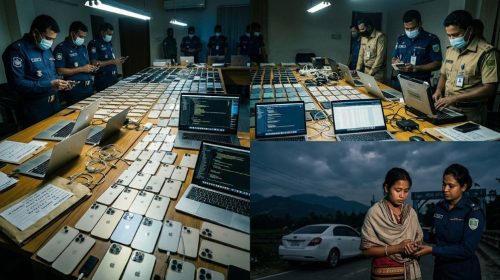
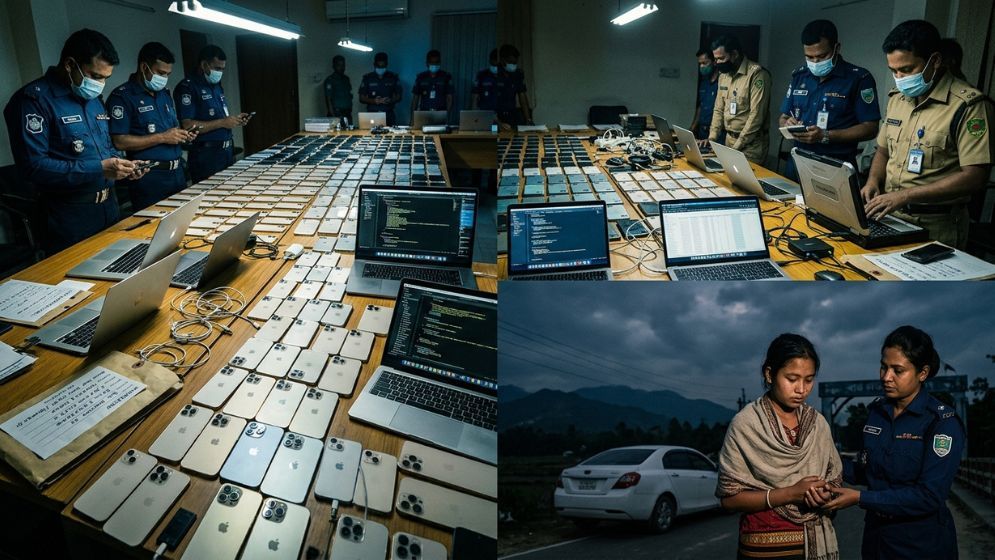
Bangladeshi police recently arrested five Chinese nationals and one Taiwanese national in an investigation into an alleged international online-fraud operation. Police seized 1,938 iPhones, 30 laptops and other communications equipment, according to mainstream media reports. A Cox’s Bazar court subsequently sent the six detainees to jail.
More disturbing is what investigators say about the wider network.
Police sources cited by Bangladeshi media say approximately 250–300 Chinese and Taiwanese nationals were allegedly connected to the operation. Reportedly the suspected network scattered following the arrests.
That figure must be treated carefully. It does not mean Bangladesh has discovered 300 proven criminals. They are suspects or unidentified people allegedly connected to the investigation. But even as a police estimate, the number raises a question that Dhaka cannot duck:
How did a network of this apparent scale establish itself in Cox’s Bazar?
That is the real national-security question.
Cox’s Bazar is not just a tourist destination. It sits beside Myanmar, the Bay of Bengal and one of the most strategically sensitive parts of Bangladesh. It is also close to the Rohingya refugee camps and to the complex security environment created by the conflict in Myanmar.
A large foreign criminal network operating from hotels and rented premises in such a location should automatically trigger scrutiny from more than ordinary police units.
It should interest immigration authorities, financial-intelligence agencies, cybercrime investigators and national-security agencies.
The CHT warning
The second warning is more human—and potentially just as serious.
Bangladeshi media investigations have documented allegations that vulnerable women are being targeted through cross-border marriage arrangements with Chinese nationals.
One recent investigation reported the case of a 19-year-old Bangladeshi woman who alleged that she was deceived, drugged, forced into marriage with a Chinese man and trafficked to China. The case involved intermediaries who allegedly facilitated the marriage.
More troubling for Bangladesh is evidence involving the Chattogram Hill Tracts.
The media reported that trafficking networks were allegedly targeting Bangladeshi women, including Indigenous women from the CHT. A Chakma woman in Rangamati filed a case alleging that her 21-year-old sister had been taken to Dhaka and forced to marry a Chinese man. Separately, a 21-year-old Marma woman from Khagrachhari alleged that traffickers compelled her to marry a Chinese national before she was rescued.
These are allegations and individual cases; they should not be converted into an assertion that every Chinese-Bangladeshi marriage is fraudulent.
But another statistic demands attention.
At least 4,226 Bangladeshi women travelled to China on family or Q-1 visas between 2020 and 2025. The annual number increased from only 35 in 2022 to 1,016 in 2023, 1,378 in 2024 and 1,721 in 2025.
Again, those numbers do not establish trafficking.
They establish something else: a rapidly expanding migration channel that requires serious oversight.
And Beijing itself has recognised the danger. The Chinese embassy in Dhaka has warned Chinese citizens against illegal matchmaking and schemes involving the purchase of foreign brides, cautioning that unlawful cross-border marriages can lead to prosecution for human trafficking.
That is significant.
Bangladesh and China should therefore treat marriage trafficking as a joint law-enforcement problem, not as an embarrassing bilateral issue to be quietly managed.
Bangladesh should learn from Southeast Asia
There is a much larger regional lesson.
Across Southeast Asia, scam centres involving Chinese gangs have evolved into sophisticated criminal ecosystems involving online fraud, money laundering, human trafficking and forced labour. Reuters has documented the growth of scam compounds along the Myanmar-Thailand border and elsewhere.
In July, Reuters reported that the UN’s migration agency estimated that scam centres across Myanmar, Cambodia and Laos could involve as many as 300,000 workers, with people from more than 80 countries being lured or trafficked into such operations.
This is no longer simply internet fraud.
It is an industrial form of transnational organised crime.
And the marriage dimension is also regional. Research published by the Migration Policy Institute notes that China’s demographic imbalance and economic strength have driven marriage migration from Southeast Asia, while warning that voluntary migration and forced trafficking can be difficult to distinguish.
That is precisely why Bangladesh needs systems capable of identifying the difference.
The investment-security question
There is an uncomfortable geopolitical dimension.
Chinese companies are already deeply involved in Bangladesh’s infrastructure and commercial landscape. Chinese engagement includes major projects involving ports, transport and other strategic infrastructure. Reuters reported earlier this year that China’s influence in Bangladesh is likely to deepen as Dhaka’s relations evolve with partner countries.
That is normal geopolitics.
But economic engagement also means access—to markets, infrastructure, logistics, telecommunications, data and people.
Bangladesh therefore needs a modern foreign-investment security framework.
Not because Chinese investment is uniquely dangerous.
Because any major foreign economic presence in strategically sensitive sectors deserves security scrutiny.
Western countries do it. China itself does it. Bangladesh should do it too.
And then there is espionage
Here the language must be especially disciplined.
There is no justification for claiming that Chinese companies operating in Bangladesh are intelligence fronts without evidence.
But Bangladesh should not ignore the international security environment either.
In September, Reuters reported that US officials accused Chinese state-owned shipping company COSCO of using concealed equipment aboard vessels to collect signals intelligence near the coastlines of strategically important countries. Beijing’s embassy in Washington denied the allegations.
Separately, cybersecurity company CrowdStrike reported this year that China-linked hackers represented the biggest espionage threat to technology companies in its assessment of the previous year, with campaigns focused on strategically valuable technology and information.
These are not allegations against Chinese.
They are reminders of the environment in which Bangladesh operates. And Bangladesh’s strategic geography makes the issue more sensitive.
A country positioned between strategic competition between China and India, overlooking the Bay of Bengal and bordering a conflict-ridden Myanmar cannot afford to treat cyber security, foreign investment, maritime infrastructure and intelligence as entirely separate compartments.
The Regional factor
Dhaka must also understand the diplomatic consequences.
If Chinese-linked criminal networks were allowed to establish significant operations in Bangladesh, neighbouring India would inevitably take an interest. So would other regional countries whose citizens or financial systems became targets.
The danger is not merely that Bangladesh could become a base for fraud.
It could acquire a reputation as a soft jurisdiction—a place where foreign criminal groups can rent property, recruit local intermediaries, move money, obtain communications equipment and disappear across borders.
Once that reputation develops, removing it is extraordinarily difficult.
The answer is neither Sinophobia nor complacency
The answer is disciplined statecraft.
Bangladesh should welcome legitimate Chinese investment and legitimate Chinese citizens.
But it should simultaneously establish a specialised mechanism to map foreign-linked organised crime.
Immigration records, hotel registrations, company ownership, property leases, financial transactions and telecommunications activity should be cross-referenced when credible criminal indicators emerge.
Marriage brokers dealing with foreign nationals should be licensed and monitored.
The CHT requires a dedicated anti-trafficking programme involving Indigenous communities themselves.
Cox’s Bazar requires enhanced scrutiny because of its geographical and strategic sensitivity.
And intelligence agencies should map whether the suspects arrested in Cox’s Bazar had connections outside Bangladesh—to Southeast Asia, China, Myanmar or other jurisdictions.
Most importantly, Dhaka should talk openly to Beijing.
China has an obvious interest in stopping its own citizens from becoming victims or perpetrators of international criminal schemes. Bangladesh should use that common interest.
The choice is between lawful partnership and unregulated vulnerability.
The Cox’s Bazar arrests are therefore not merely a police story.
They are a warning.
The question Bangladesh should now be asking is not how many foreigners were arrested.
It is who brought them here, who financed them, who rented them the premises, where their money went, whom they communicated with, whether they had local facilitators—and whether the Cox’s Bazar operation was an isolated criminal enterprise or part of a wider regional network.
Likewise, the women allegedly trafficked through sham marriages must not be treated as unfortunate victims of private relationships. Their cases should be investigated as potential organised crime.
Bangladesh has an opportunity to act while these networks are still visible.
Once they morph into legitimate businesses, property holdings, marriages, digital infrastructure and cross-border financial channels, the task will become infinitely harder.
The warning signs are already before us. The responsibility now rests with Dhaka to act decisively—before scattered incidents harden into an entrenched security threat.