



For many Dhaka residents, the struggle over a loved one’s grave does not end with burial. With the city facing a severe shortage of burial space, ordinary graves are generally reused after two years, while families seeking to preserve a grave for longer periods have to pay substantial fees ranging from several lakh taka to crores of taka.
Poet Jasimuddin’s famous poem ‘Kabor’ evokes the enduring pain of losing loved ones. But for most people in Dhaka, the opportunity to return decades later and identify a loved one’s grave is becoming increasingly difficult.
The soil where parents, grandparents and ancestors lie is more than just a piece of land. It represents roots, memories and an enduring connection with loved ones. Yet in a city of nearly three crore people, there is no guarantee that such memories will remain preserved.
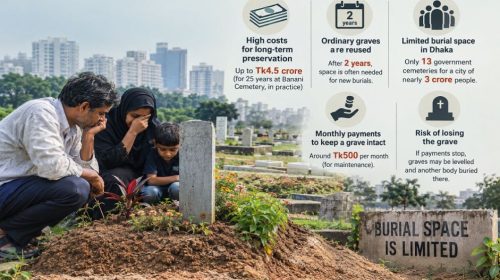
In many cases, families pay monthly to keep a grave intact. For long-term preservation, the cost can run into lakhs or even crores of taka. At Banani Graveyard, preserving a grave for 25 years can cost up to Tk4.5 crore in practice. Those unable to afford such costs may find an unfamiliar person buried in the same spot after two years.
Paying every month to preserve a grave
In April 2025, when Rafiqul Islam, a resident of Sutrapur in Old Dhaka, died, his family took his body to Jurain Graveyard. The prescribed burial fee at the time was Tk1,000.
But the family’s expenses did not end there.
Ahaduzzaman, a relative of Rafiqul, told the media on Monday that although the official fee was Tk1,000, the family had to spend at least Tk10,000 to complete the burial. They also paid Tk300 for a wooden nameplate and another Tk1,000 as a one-off payment for decorating and temporarily preserving the grave.
They were subsequently asked to pay Tk500 every month to keep the grave intact.
According to his allegation, the family was told that if the monthly payments stopped, the grave could be levelled and another body buried there.
Amid the grief of losing a loved one, the family therefore faced another worry: how long would the grave remain?
Unable to afford preservation for a fixed period by paying a large sum, the family has instead been trying to keep the final resting place intact through monthly payments so that future generations can visit the grave and offer prayers.
A network of more than 100 people around some cemeteries
City corporation-controlled graveyards have their own cleaners and khatolis, or workers involved in carrying bodies. Each cemetery generally has 15 to 20 such workers, and sometimes more.
However, an investigation found that networks involving at least 100 to 150 people are active in some graveyards.
They are not officially employed by the authorities. Identifying themselves as “support workers”, they are involved in various activities ranging from burial to grave maintenance.
Families are charged between Tk2,000 and Tk6,000 for putting up bamboo fencing around a grave and around Tk1,000 for decorating a grave or planting grass. The network also collects Tk300 to Tk500 a month for watering and regular maintenance.
No formal involvement of the city corporation in these activities was found. However, people concerned with the cemeteries have reportedly remained indifferent to the activities of the network.
A worker who has been employed at Rayerbazar Graveyard for about 15 years admitted that such payments are collected from relatives. He claimed that a portion of the money also goes to dishonest city corporation employees.
What do the rules say?
The Dhaka North City Corporation Graveyard Policy-2022 states that permanent structures or fencing using bamboo, bricks, iron grills or other materials cannot be constructed in ordinary graves.
Although ordinary graves can officially be used for up to two years, there are reports of grave markers disappearing even earlier.
Relatives allege that if they do not visit a grave regularly or stop paying for its maintenance, some graves are levelled within six months to a year, after which another body is buried there.
Another long-standing problem has also resurfaced: the digging up of old graves and theft of bones and skeletons. Information has emerged about criminal networks involved in collecting and selling human remains. There are allegations that such crimes take place under the protection of dishonest groups operating around cemeteries.
Money can preserve a grave—but at a huge cost
Those who can afford it can preserve a grave for 15 or 25 years.
According to the Dhaka North City Corporation’s Graveyard Policy-2022, preserving a grave at Banani Graveyard costs Tk1 crore for 15 years and Tk1.5 crore for 25 years.
At Uttara Sector 4 Graveyard, the fees are Tk75 lakh and Tk1 crore respectively. At Uttara Sector 12, they are Tk50 lakh and Tk75 lakh, while at Uttara Sector 14 they are Tk30 lakh and Tk50 lakh.
At Mirpur Shaheed Buddhijibi Graveyard, the fees are Tk20 lakh for 15 years and Tk30 lakh for 25 years. At Rayerbazar, adjacent to the Badhyabhumi, the fees are Tk10 lakh and Tk15 lakh respectively.
However, in practice, preserving a grave can cost much more than the official fees. At Banani Graveyard, the amount reportedly rises to as much as Tk4.5 crore.
A fee of Tk50,500 is charged for burying another family member in the same grave at Banani, while the fee is Tk30,500 at other graveyards. The opportunity for reburial is not open to everyone, however. The policy limits it to the deceased’s children, spouse, parents and siblings.
Permanent purchase of burial land is also not available at Dhaka South City Corporation Graveyards. Depending on the preservation period, families have to pay between Tk5 lakh and Tk20 lakh—Tk5 lakh for 10 years, Tk10 lakh for 15 years, Tk15 lakh for 20 years and Tk20 lakh for 25 years.
Not everyone can afford such sums.
Abu Raihan, a resident of Uttara Sector 4, said his maternal uncle, Abdul Ali, died three years ago and the family wanted to bury him at a local cemetery. Most of their relatives live in Dhaka, so they hoped local burial would allow them to visit his grave more easily.
But the family could not afford the cost of preserving the grave for years. They eventually had to take Abdul Ali’s body to their ancestral home in Kushtia for burial.
Preservation costs have soared
The cost of preserving graves has increased sharply in a relatively short period.
According to old documents, in 1996, permanently purchasing burial space at Banani and Uttara Sector 4 graveyards cost Tk1.2 lakh. At Mirpur Shaheed Buddhijibi Graveyard, burial space was available for Tk25,000 to Tk35,000. The system remained broadly unchanged until 2005.
Permanent purchase of grave space was suspended from 2005 to 2007. A term-based preservation system was introduced in 2008.
Before the preservation fees were increased in 2023, the maximum fee at Banani was Tk24 lakh for 15 years and Tk45 lakh for 25 years. Although the official fees are now Tk1 crore and Tk1.5 crore respectively, the actual cost can reportedly reach Tk4.5 crore.
Advance grave preservation at seven DNCC Graveyards is now completely suspended. Preservation for 15 or 25 years is allowed only subject to approval from the authorities and availability of space.
The policy allows a grave to be preserved for a maximum of 25 years at a time. A fresh approval is required if the family wants to extend the preservation period after it expires.
There is a special provision for Bir Muktijoddhas, or freedom fighters. Subject to their names appearing on the integrated list of the Ministry of Liberation War Affairs and submission of proper certificates, their graves can be preserved free of charge for the first 10 years with the approval of the authorities. Around 1.5 acres of land has been reserved for them at Mirpur Shaheed Buddhijibi Graveyard.
‘Fees raised to discourage long-term preservation’
The Dhaka North City Corporation says it has not increased the cost of ordinary burials. The high fees apply only to long-term grave preservation.
DNCC Chief Social Welfare and Slum Development Officer Mohammad Mamun-ul-Hasan told the media that fees were being collected under the graveyard policy introduced in 2023.
“We are collecting fees according to our 2023 graveyard policy. No new fees have been increased. Our Chamurkhan Graveyard is new. This makes seven cemeteries,” he said.
He said the cost of ordinary burial had not increased.
“The preservation fees have been increased to discourage people from preserving graves for long periods. If everyone wants to preserve graves, there will be no burial space left in Dhaka. Otherwise, the fees and costs for ordinary burials remain within the means of city residents,” he said.
Although the official referred to the policy as the 2023 policy, its formal title is the Dhaka North City Corporation Graveyard Policy-2022. The policy came into effect on 18 January 2023.
Up to seven people buried in the same grave
According to city corporation data, the city of three crore people has only 13 government cemeteries. Together, they cover 253 acres and have a combined burial capacity of 233,578 people.
Of the total cemetery land, 192 acres are under Dhaka North City Corporation and only 61 acres under Dhaka South City Corporation.
The limited burial space compared with the city’s population has made the reuse of old graves an unavoidable reality of graveyard management in the capital.
The shortage is particularly acute at Banani Graveyard. With more than 9,000 graves, the cemetery has no space for new burials. Ordinary graves are therefore reused after two years.
There are also instances of several members of the same family being buried in preserved graves. As many as seven people have reportedly been buried in some graves.
According to DNCC, the crisis was aggravated when people were allowed to purchase grave space in advance while still alive. That option has now been stopped at Banani.
Disputes over burial land are not new
The crisis over burial space is not new.
In 2006, the then undivided Dhaka City Corporation moved to demolish more than 100 permanent and temporary graves at Azimpur Graveyard to build a road. It was alleged that the initiative was taken under the influence of a local member of parliament.
Following a writ petition filed by Advocate Manzil Morshed on behalf of Human Rights and Peace for Bangladesh, the High Court declared the decision to demolish the graves and construct the road illegal. The relevant rule was subsequently made absolute.
Allegations of irregularities in cemetery management have also emerged at different times.
The Anti-Corruption Commission investigated allegations of corruption, abuse of power and bribery against then-DNCC administrator Mohammad Ejaz. There have also been allegations of collusion between dishonest employees and informal networks operating around graveyards.
Source: Kaler Kantho