





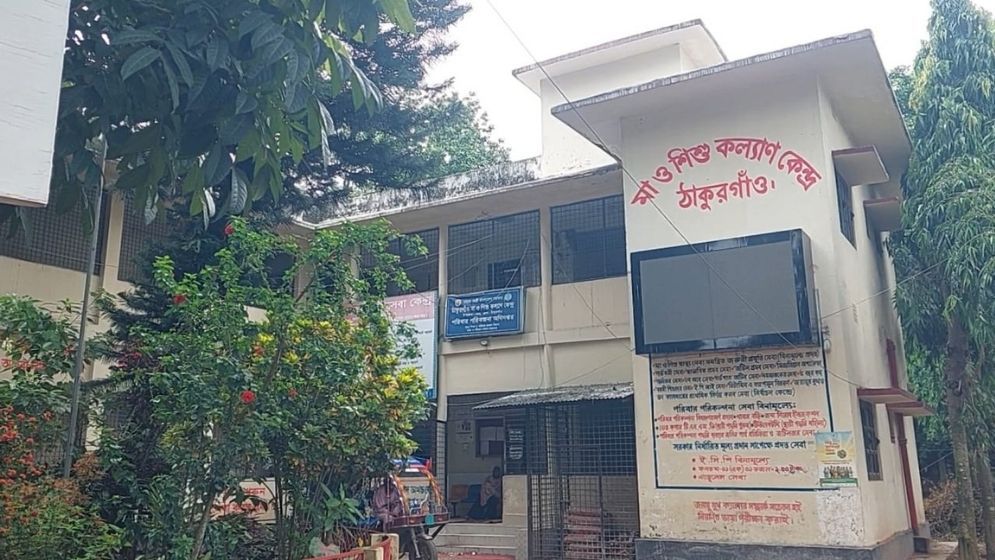

Rasheda Akter had been receiving regular medical advice at the Thakurgaon Mother and Child Welfare Centre since the beginning of her pregnancy. Hoping for safe delivery at the government-run facility because of its affordable costs and the assurances of doctors, she arrived at the hospital last Thursday in labour.
However, she was left devastated after doctors informed her that a normal delivery would not be possible and that an emergency caesarean section was needed. But the centre has been unable to perform caesarean sections for the past four months due to the absence of an anaesthetist. Rasheda was therefore advised to go to a private hospital.
Rasheda broke down in tears in the hospital corridor after hearing the news.
Her husband works at a small shop, and the couple cannot afford the high cost of a caesarean section at a private clinic.
“I had been consulting doctors at this hospital since the first month of my pregnancy. They told me that everything would be arranged here. Now, at the last moment, they are telling me that a caesarean cannot be performed and that I should go elsewhere. Can poor people like us afford a private clinic? If the facility were available here, we would not have faced this situation,” Rasheda Akter told this correspondent, with tears in her eyes.
Rasheda is not alone. Hundreds of pregnant women from distant areas are facing similar hardships after coming to the facility.
Caesarean services for pregnant women have remained suspended at the Thakurgaon Mother and Child Welfare Centre since February due to the absence of an anaesthetist. As a result, poor patients are being forced to rush to private clinics or the district hospital in emergencies.
A visit to the facility found that its wards, once crowded with expectant mothers and newborns, are now largely empty. The door of the operation theatre was locked, with no sign of activity.
Rasheda’s husband, Zahirul Islam, expressed his frustration.
“We had hoped to receive good treatment at a low cost at a government hospital. But now we are being sent to private clinics halfway through the process. We are taking her to a private hospital by borrowing money, but I do not know how we will repay such a large amount,” he said.
Farida Begum, who came from Balia union in Sadar upazila, also expressed similar helplessness.
“This hospital was the only hope for people in the villages. We could receive good services at a low cost. But after coming here, we were told that there was no doctor and that caesarean sections were not being performed. People like us are at our wits’ end,” she said.
A patient’s relative, Shahin Alam, said hospital authorities often referred patients to other hospitals as soon as a normal delivery was deemed impossible.
“Moving a patient from one hospital to another in an emergency is risky, while arranging the extra money is also extremely difficult,” he said.
An investigation found that the centre has also been facing a shortage of medical supplies for a long time. Delivery kits required for normal deliveries are not available in adequate quantities, disrupting services.
Moreover, the centre’s only ambulance has remained out of order for the past two years.
Medical Officer of the Thakurgaon Mother and Child Welfare Centre Laboni Basak acknowledged the problems.
“Our only anaesthetist retired in February. He continued working for an additional month after his retirement in the interest of the pregnant women. The post has remained vacant since then. Caesarean operations cannot be performed without an anaesthetist. So we are compelled to refer complicated cases,” she said.
Laboni Basak further said the centre had not received any government allocation or budget for ambulance fuel for the past two years.
“The hospital owes around Tk4.5 lakh to a local petrol pump. As the dues have not been paid, the pump authorities have stopped supplying fuel,” she said.
Confirming the shortage of medical supplies, she said the centre required 10 to 12 delivery kits every month but received only eight in January and two in February.
“The shortage has worsened since then,” she added.