





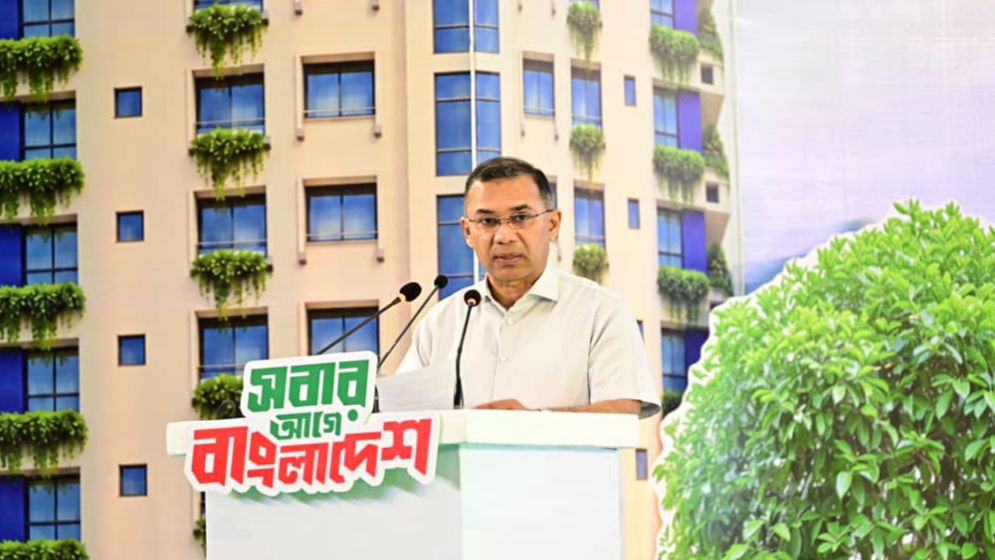

Prime Minister Tarique Rahman on Monday pledged to ensure safe, affordable and sustainable housing for all citizens while pursuing planned and decentralised urban development across Bangladesh.
“Liveable, affordable, environmentally friendly and safe housing with basic services for all, or universal housing, is a fundamental constitutional right of citizens. The government is firmly committed to ensuring and safeguarding this right,” he said.
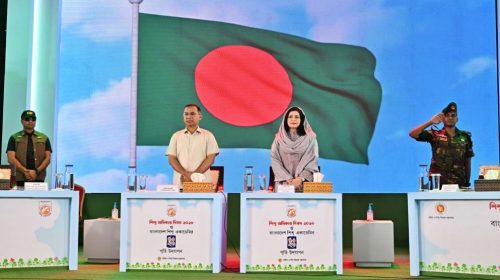
The prime minister made the remarks while addressing a discussion marking World Habitat Day 2026 at the Bangladesh-China Friendship Conference Centre in Dhaka.
The Ministry of Housing and Public Works organised the programme under the theme “Universal Housing, Sustainable Urbanisation.”
Tarique said ensuring planned urbanisation and housing facilities for low- and lower-middle-income people is one of the government’s major electoral commitments.
He said the government is taking steps to prepare master plans for city corporations and districts across the country to ensure planned urban development.
Housing, he said, should not be viewed merely as a physical structure, but as a comprehensive living environment that includes safe drinking water, uninterrupted electricity, improved sanitation, public transport, better road management, education and healthcare facilities, employment opportunities and a safe environment for a dignified life.
“It is now a necessity not only to provide housing for citizens but also to ensure that such housing is safe and sustainable,” Tarique said.
The prime minister acknowledged that ensuring such housing for all is more challenging in a densely populated country like Bangladesh than in developed countries.
“Yet, if we want to survive with dignity in a competitive world, we must move forward by facing every challenge and keeping pace with the rest of the world,” he said.
Pressure on cities
Tarique said population pressure is continuously increasing in cities, towns and urban centres across Bangladesh, with Dhaka now “overpopulated” by any standard.
Other major cities are also facing similar pressures, he said, making universal housing and sustainable urbanisation particularly important for Bangladesh.
The prime minister, however, acknowledged that implementing these goals would be more difficult than articulating them given the country’s existing realities.
He said the government was taking various steps to address the challenges and implement its plans.
Master plans, secondary townships
The government is working to reduce population pressure on urban areas by improving fast, affordable and safe connectivity between Dhaka, other cities and the rest of the country, Tarique said.
At the same time, it is working to improve civic amenities in rural areas so that better facilities outside cities can help reduce pressure on urban centres.
Tarique said development in Bangladesh had previously been concentrated around Dhaka and a few major cities.
The government now wants to bring every region into the mainstream of national development and promote decentralised and balanced urban and regional development, he said.
“Our goal is not to concentrate urban development in one particular place. Rather, we want balanced and decentralised urban and regional development so that development spreads across all areas,” he said.
The Ministry of Housing and Public Works is working on a nationwide planning initiative as well as a plan to develop secondary townships around Dhaka, the prime minister said.
He said new development authorities had already been established in Sylhet, Mymensingh, Barishal, Cumilla, Rangpur and Narayanganj to facilitate planned urbanisation in those areas.
Tarique expressed hope that these initiatives would contribute to achieving Sustainable Development Goal 11, which calls for inclusive, safe, resilient and sustainable cities and communities.
“It will take time, but we will be able to achieve it gradually, InshaAllah,” he said.
Environment at centre of housing plans
Environmental protection is a major consideration in the government’s plans for liveable housing and urban development, Tarique said.
The government has set a target of planting 250 million trees across the country over the next five years, he said.
The prime minister also stressed the need for effective waste management in Dhaka and other city corporations and districts, saying the government was working to properly manage the growing volume of waste generated by daily activities.
Population pressure and rapid urbanisation have made proper waste management increasingly important for protecting the environment, he said.
Public-private cooperation needed
Tarique said tackling the housing crisis in urban areas would be difficult for the government alone and called for coordinated participation by major entrepreneurs and stakeholders in the housing sector.
Private-sector stakeholders could play an important role in addressing housing challenges and ensuring affordable, environmentally friendly and safe housing with basic services, he said.
The government is also working on block-based housing schemes, area-based parks and playgrounds, and designated industrial zones as part of its broader urban planning efforts.
The prime minister expressed confidence that the government would gradually implement its plans and make safe housing for all a reality for the citizens of Bangladesh.
He wished success for the World Habitat Day 2026 programmes and formally inaugurated the event.
Environment, Forest and Climate Change Minister Abdul Awal Mintoo, Housing and Public Works Minister Zakaria Taher Sumon, State Minister for Housing and Public Works Ahmad Sohel Manzur, ministry secretary Md Obaidur Rahman and UN Resident Coordinator in Bangladesh Carol Flore-Smerecznia, among others, addressed the programme.
Before joining the programme, the prime minister planted a Swarna Champa on the premises of the conference centre.
He later inaugurated a three-day housing fair at the Bangladesh-China Friendship Conference Centre.
Various organisations from the housing and construction sectors, along with different departments and agencies under the Ministry of Housing and Public Works, are participating in the fair.
The prime minister visited different stalls at the fair and later signed the visitors’ book.
World Habitat Day is also being observed across all divisions and districts through various programmes, including publication of a souvenir, special discussions on television and radio, and the display of banners, posters and festoons at important locations.
Bangladesh and countries around the world have observed World Habitat Day since 1986.
A special documentary on World Habitat Day 2026 was screened at the programme, where the prime minister also unveiled a souvenir marking the day.