










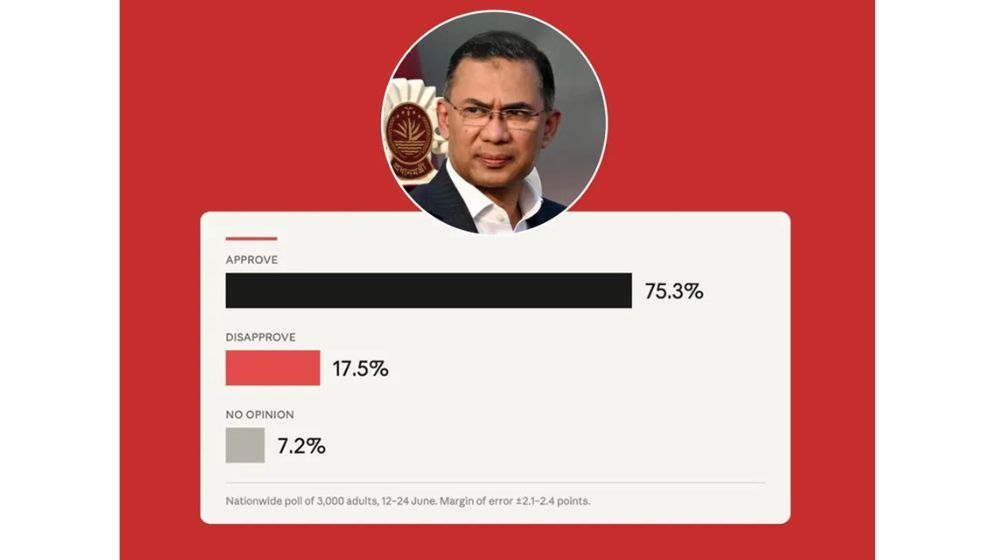

More than three-quarters of Bangladeshis approve of the way Prime Minister Tarique Rahman is handling his job, according to a nationwide poll by The Deltagram, four months after the Bangladesh Nationalist Party formed government following a landslide election victory.
The survey of 3,000 adults, conducted between 12 and 24 June by a team of interviewers trained and fielded directly by The Deltagram, found that 75.3% of respondents approved of Rahman’s performance, while 17.5% disapproved and 7.2% had no opinion.
Approval was strongest in Rangpur division, at 83.1%, and weakest in Dhaka, at 70.4%. Rural respondents approved at a notably higher rate than urban ones, 78.5% against 70.1%, and support held up fairly evenly across age groups, dipping only among the over-60s, at 70.9%.
The figures point to a strong early honeymoon for Rahman’s government, which took office on 17 February after the BNP’s victory in Bangladesh’s first general election since the 2024 uprising that removed Sheikh Hasina from power. The government has pledged to implement the July National Charter, including term limits and a two-chamber parliament, approved by voters in a referendum held alongside the election.
The poll was commissioned, designed, funded and fielded entirely by The Deltagram, using an in-house team of trained interviewers rather than a contracted survey firm. Interviewers received 15 days of training on questionnaire administration and sampling protocol, and contact outcomes (completions, refusals, non-contacts) were logged and tracked to support the AAPOR RR3 response-rate calculation reported below.
The gap between Rangpur’s 83.1% and Dhaka’s 70.4% is the most eye-catching regional finding, but it should be treated cautiously. Divisional estimates are based on far smaller numbers of sampling clusters than the national figure, roughly nine primary sampling units for Rangpur, and estimates built on fewer clusters carry wider true margins of error than the survey’s standard calculation accounts for. In practice, part or all of the Rangpur-Dhaka gap may reflect sampling variation rather than a genuine difference in opinion between the two divisions, and it shouldn’t be read as a precise ranking.
Interviews were conducted 70% face to face and 30% by mobile phone, a common approach in a country with uneven phone coverage. Face-to-face approval (75.8%) came in slightly higher than phone approval (74.1%), a gap the data don’t show to be statistically significant, though the comparison hasn’t been tested as rigorously as a randomised mode study would allow. This matters because face-to-face polling on approval of a government, so soon after a change of power, can be more prone to respondents giving the answer they feel is safer. The gap found here is small and not confirmed as meaningful, but it isn’t ruled out either, and it’s a fair question for a second survey to help settle.
Methodology
The Deltagram used a two-stage stratified probability sample: 150 primary sampling units selected by probability proportional to population size across all eight divisions, with 20 interviews completed in each, for a total of 3,000 respondents. The response rate, calculated to AAPOR’s RR3 standard, was 75.7%. Results were weighted using iterative proportional fitting to Bangladesh Bureau of Statistics benchmarks for division, urban/rural residence, sex, age and education; unweighted approval was 74.1% before weighting, 75.3% after.
Accounting for the clustered sample design (a design effect of 1.82, reducing the effective sample size to about 1,648), the margin of sampling error is approximately ±2.1 to 2.4 percentage points at the 95% confidence level nationally. Regional margins are wider, from about ±4 points in Dhaka to roughly ±9 points in smaller divisions, and are likely underestimates for the least populous divisions given how few clusters they contain.