




Ensuring a women-friendly political environment in Bangladesh requires strong political will, institutional reform, and effective enforcement of existing legal provisions, speakers and researchers said at a divisional dialogue held in Dhaka on Monday.
Although political parties are legally required to ensure 33% representation of women at all levels of party committees by 2030 under the Representation of the People Order (RPO), implementation in practice remains limited.
As a result, women’s meaningful participation in political decision-making continues to lag behind expectations.
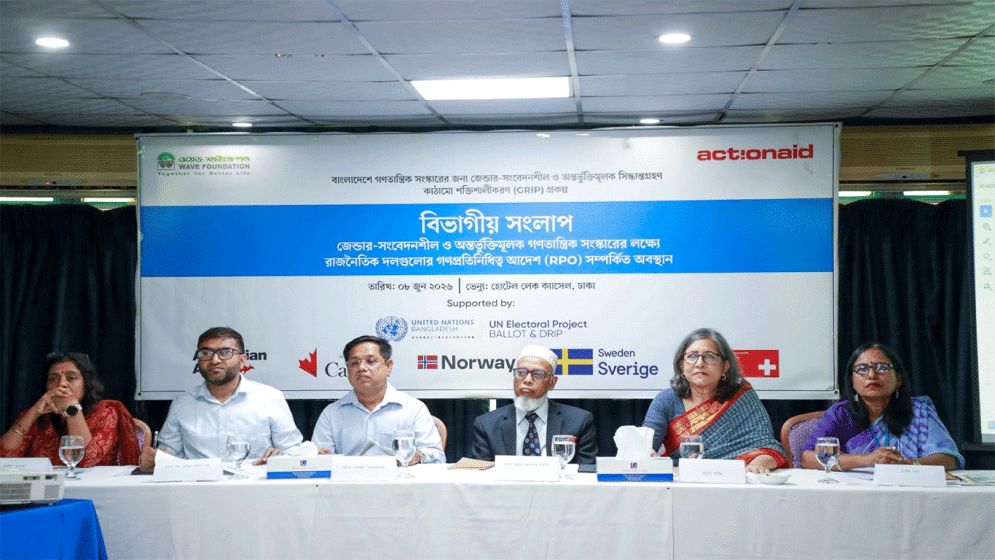
The issue was highlighted at a discussion titled “Political Parties’ Position on the Representation of the People Order (RPO)”, jointly organised by Wave Foundation and ActionAid Bangladesh under the Gender Responsive and Inclusive Participation (GRIP) Project, part of the UN electoral assistance initiatives BALLOT and DRIP.
The research, conducted by Sanaia Fahim Ansari and presented by consultant Mansura Akhtar, was based on the views of 191 stakeholders from 11 districts across six divisions.
At the event, participants stressed that women’s political participation should not be limited to reserved seats or quotas, but must be ensured at all levels of party decision-making.
The study found that 87.3% of respondents are aware of the 33% women’s representation requirement in political parties. However, 72% believe the provision is not being effectively implemented.
Only 1.4% of respondents think the Election Commission (EC) has adequate capacity to enforce compliance, while 9.9% consider its capacity partially sufficient, indicating significant concerns about institutional enforcement.
The research identified several barriers to women’s political participation. According to respondents, 60.6% pointed to patriarchal party culture as the main obstacle, while 56.3% cited a lack of political commitment.
Family and social pressure was mentioned by 49.3%, and 45.1% highlighted the absence of democratic practices within political parties.
Additionally, 39.4% identified weak monitoring and follow-up by the EC.
Young women face additional challenges, including fear of insecurity and online violence, male-dominated political structures, negative social attitudes, limited party opportunities, and financial constraints.
The dialogue proposed several reforms to strengthen women’s political participation. These include regular audits by the EC to monitor compliance with gender provisions, mandatory publication of gender-disaggregated data on party representation and nominations, and stronger enforcement of RPO requirements.
Participants also recommended expanding women’s participation beyond general committee roles into key decision-making bodies, including party nomination committees. They further suggested introducing state incentives for parties that nominate more women candidates and reducing nomination fees for women.
Other recommendations included strengthening internal party accountability, introducing structured political mentorship, and providing institutional training programmes for emerging women leaders.
Speaking at the event, Tapati Saha, programme manager for gender responsive governance at UN Women Bangladesh, said the participation of stakeholders from across multiple districts enriched the discussion and reaffirmed UN Women’s commitment to supporting inclusive democratic reforms.
Earlier, ActionAid Bangladesh Country Director Farah Kabir said the goal is not only to identify institutional gaps but to develop sustainable solutions that enable all stakeholders to contribute effectively.
Wave Foundation Deputy Director Kaniz Fatima noted that implementation gaps remain a major challenge in enforcing the RPO, while concerns over women’s safety and political participation were repeatedly raised during discussions.
Representatives from the Bangladesh Nationalist Party (BNP), National Citizen Party (NCP), AB Party, EC officials, UN agencies, civil society members, legal experts, researchers, media professionals, and youth representatives also participated in the dialogue.