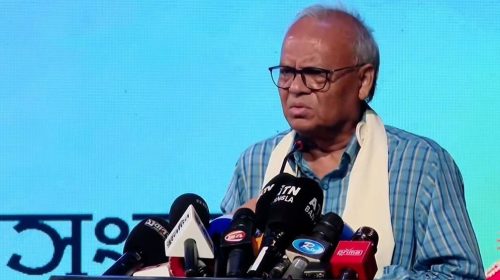


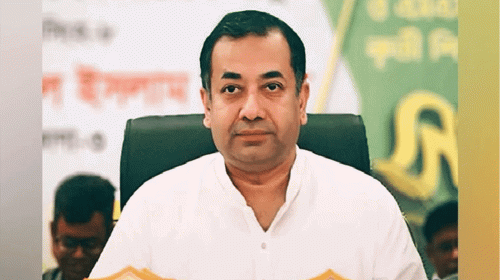



Member of Parliament (MP) from Pabna-5 (Sadar) constituency Advocate Shamsur Rahman Shimul Biswas said on Friday that workers’ safety, dignity, fair wages and rights must be ensured alongside technological advancement and changes in the world of work.
“We do not want a future where technology advances but workers are left behind. We want an economy where productivity rises, industries become competitive and investment increases, but the foundation of that growth is workers’ fair rights, safety and dignity,” he said.
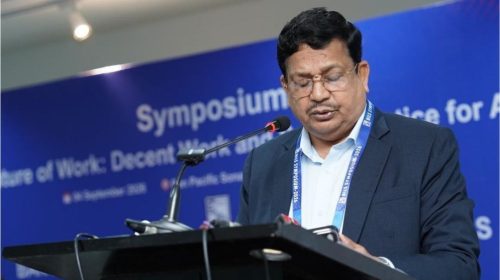
Shimul Biswas, also the Coordinator of Jatiyatabadi Sramik Dal, made the remarks while speaking at an international labour symposium titled “Future of Work: Decent Work and Social Justice for All”, organised by the Bangladesh Institute of Labour Studies (BILS) at Pan Pacific Sonargaon Dhaka on Friday.
Prime Minister’s Economic and Planning Adviser Dr Rashed Al Mahmud Titumir attended the event as the chief guest.
Shimul Biswas said the nature of work is changing rapidly due to technological advancement, changes in production systems and climate change, creating new forms of employment.
However, he said, the safety, dignity, fair wages and rights of workers and their families must remain at the centre of these changes.
A large portion of Bangladesh’s workforce is engaged in informal employment, he said, adding that millions work in agriculture, construction, transport, domestic services, fisheries, small and cottage industries, home-based work and platform-based employment.
Many of these workers, however, lack job security, legal protection, social security, healthcare and labour rights, he said.
Highlighting workers’ basic demands, Shimul Biswas called for fair wages, implementation of an eight-hour working day, fair payment for overtime, job security, safe working conditions, trade union rights, collective bargaining opportunities, timely payment of wages, equal rights for women workers, social protection and dignity at the workplace.
He said various workers’ organisations had demanded that the national minimum wage be set at Tk30,000.
He also stressed adjusting wages in line with inflation, ensuring working-hour regulations, creating a database of informal workers and protecting employment amid technological changes.
“Amendments have already been made to the Bangladesh Labour Act. This is certainly important progress. But enacting a law is not the end of the matter. The real measure of our success will be how effectively the law is implemented, how much protection workers receive and how far they can exercise their rights in practice,” he said.
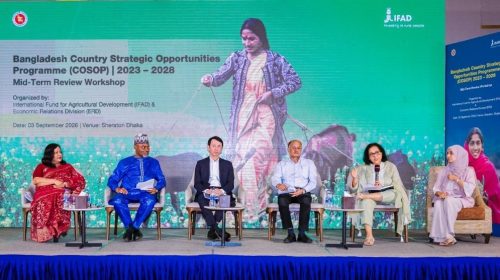
Representatives from Denmark, the Netherlands, Japan, Panama, the Philippines, Tunisia, the International Labour Organisation (ILO), Pakistan, India and other countries attended the symposium.
Various views and recommendations were put forward on addressing future challenges in the labour sector.