









The European Union (EU) has praised the intervention and steps of the interim government in improving the quality of the data important in the context of implementing a development plan of a country.
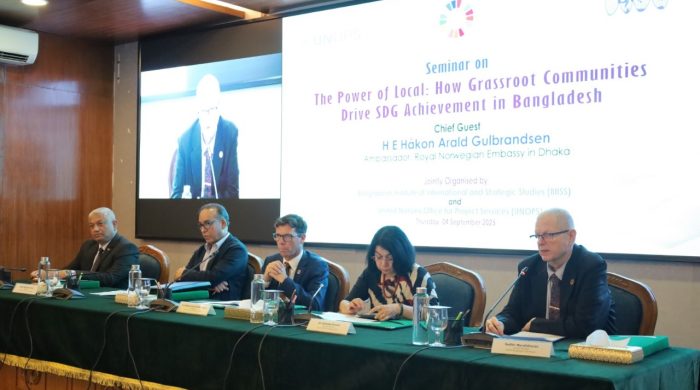
Dr Michal Krejza, Head of The Development Cooperation and Minister counsellor of the Delegation of the European Union (EU), has expressed this view while speaking at a seminar on “The Power of Local: How Grassroots Communities Drive SDG Achievement in Bangladesh, organized by the Bangladesh Institute of International and Strategic Studies (BIISS) and the United Nations Office for Project Services (UNOPS) in the city on Thursday.
Since August 5, 2024, the environment has been changed with stakeholders have started questioning the quality of the data prepared and used by the previous government.
It is to be mentioned here the past Bangladesh Awami League manipulated the data in suppressing the real economic scenario and the data of gross domestic product (GDP) growth, export, import, employment and poverty level have been manipulated to paint a bright scenario of the country.
Dr. Michal Krejza, a Dutch citizen, sharing his personal experience in the Netherlands said that his country has vast experience in Delta management and the Dutch govt involves local community in planning and implementing development projects”
He added: “The Sustainable Development Goals (SDGs) cannot succeed through a top-down approach. Involving local communities is paramount. The EU has consistently supported Bangladesh in localizing the SDGs, with women at the center.”
Norway Ambassador in Dhaka Håkon Arald Gulbrandsen in his speech said“ Bangladesh has made notable progress in achieving the 2030 Agenda, overcoming the resource constraints and challenges imposed by climate vulnerability. To promote SDG implementation, the government of Bangladesh has established an Inter-Ministerial Committee on SDGs Implementation, developed an SDG Tracker with 39 indicators, and charted a National Action Plan of Ministries/Divisions for the Implementation of SDGs with specific targets for each ministry/ division.”
Håkon Arald Gulbrandsen said“ Localization of the SDGs, on the other hand, involves integrating them into local development plans and empowering local governments to achieve them. I can mention the Natore Model in this regard. The local government administration of Natore District of Bangladesh has developed an SDG District Action Plan, commonly known as the “Natore Model”, to achieve the convergence of all government offices and stakeholders based on the 2030 Agenda. This model implements SDG at the district level to address local problems, potentials, and action programs for all government agencies. Since it has the potential of being replicated in other government administrations, it has now been defined as a model by the government of Bangladesh.”
He highlighted the role of the Norwegian Government in the effort of localizing SDGs in developing countries. In such efforts, Norway usually focuses on human rights, governance, peace, gender equality, climate, and natural resource management.
Norway engages in political dialogue around democracy, corruption, and human rights issues, ensuring that SDG localization reflects good governance and inclusion. He also said “We support local governments with training, technical expertise, and tools to adapt SDGs into local planning and budgeting. We help to develop local SDG indicators, support statistical capacity, and data collection.”
In Bangladesh, in particular, the Norwegian fund projects that strengthen local democratic institutions by enhancing transparency and accountability. Examples are the support to BALLOT project of UNDP for a good upcoming parliamentary election in early 2026 and also a project focusing on women’s participation in politics. In recent past we supported another UNDP project focusing on tolerance and inclusivity in Bangladesh. Some Norwegian activities focus on civil society participation. It supports NGOs and local partners to increase access and promote women’s leadership in politics. Other areas of involvement include climate resilience, disaster risk reduction, renewable energy initiatives, and climate adaptation projects.
Norway also supported in the past women’s rights organizations, legal aid NGOs, and community climate groups directly or indirectly. All these supports were linked to MDGs in the past and SDGs in recent years.
Executive Director of the Centre for Policy Dialogue (CPD) Dr. Fahmida Khatun moderate the seminar.
Director General of BIISS Major General Iftekhar Anis emphasized, “Real progress lies in the hands of our local communities. Their lived experiences and solutions are invaluable in shaping policies that truly leave no one behind.”
Country Manager of UNOPS Bangladesh and Bhutan Sudhir Muralidharan underlined the importance of collaboration: “Together with BIISS, we are amplifying local voices and efforts. Sustainable, equitable change is only possible when it is rooted in inclusive planning and driven by community-led action.”
Delivering the keynote address, Professor of Development Studies at the University of Dhaka Dr. Maruful Islam identified gaps in data and governance at the local level: “We have the vision, but to realize it we must empower local actors, safeguard their autonomy,
and strengthen data and institutions to turn plans into tangible outcomes.”
Representing the government of Bangladesh, Planning Division Secretary Iqbal Abdullah Harun reaffirmed official commitment: “Our priority is empowering local government bodies to lead SDG implementation. Their success is our nation’s success.”
Bringing a grassroots voice, Coordinator of Nijera Kori Khushi Kabir stressed the
importance of community-driven solutions: “When communities design and drive their
own development, outcomes are more sustainable and just. This roundtable is a step
towards recognizing that power.” The discussion concluded with a collective call to strengthen local data systems, improve financing mechanisms, and advance deeper collaboration among government, development partners, and civil society to accelerate progress toward the SDGs. The Bangladesh Institute of International and Strategic Studies (BIISS) is a premier research institute dedicated to advancing policy-relevant studies on international and strategic affairs. The United Nations Office for Project Services (UNOPS) supports the UN and partners worldwide in delivering peacebuilding, humanitarian, and development projects through expertise in infrastructure, procurement, human resources and project management.