








Social media was once hailed as one of the defining technological breakthroughs of the 21st century—a force that promised to transcend borders, democratise information and give every individual an equal voice in the global conversation. It has undoubtedly transformed the way humanity communicates, learns, conducts business and engages with public affairs.
Yet, beneath this remarkable success lies a far more troubling reality. What was conceived as a platform for connection has evolved into a powerful ecosystem that shapes opinions, manipulates behaviour and increasingly dictates the rhythms of everyday life. Social media is no longer merely a tool of communication; it has become an influential force capable of altering personal relationships, public discourse and even the foundations of democratic society.
But the conversation has changed. The pressing question is no longer whether social media is good or bad. Rather, it is whether the content that dominates our screens is making us better informed, healthier and more connected—or more anxious, divided and distracted.
The answer, unfortunately, is increasingly the latter.
What makes social media so influential is not merely the technology itself but the sheer volume of content it delivers every second. News updates, political commentary, lifestyle videos, advertisements, celebrity gossip and personal opinions compete relentlessly for our attention. Behind every feed is an algorithm carefully designed to maximise engagement, not necessarily to maximise truth or well-being.
That distinction matters.
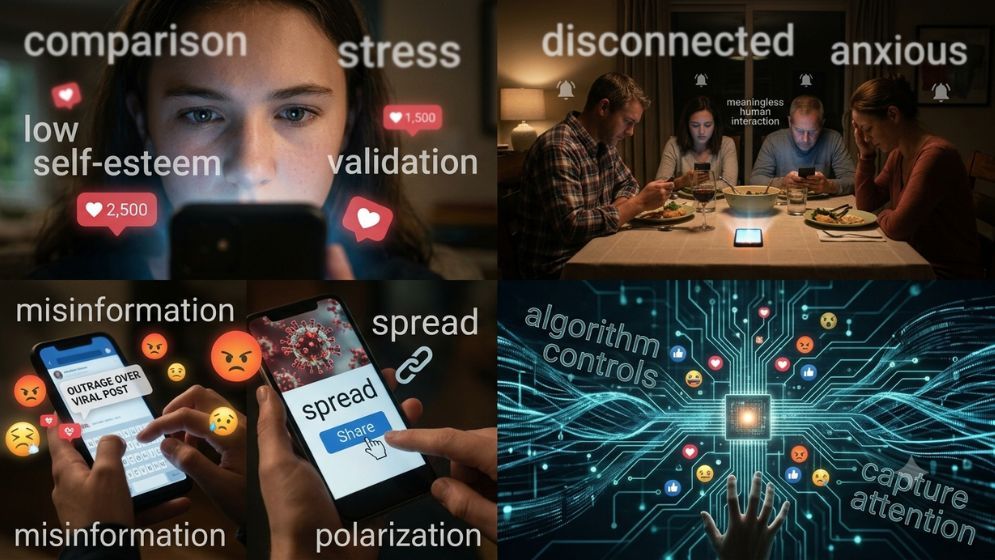
The algorithms powering today’s platforms reward content that provokes strong emotions. Outrage spreads faster than reason. Rumours travel quicker than verified facts. Sensational headlines outperform measured reporting. As a result, users are often exposed to information that reinforces prejudice, deepens political polarisation and encourages impulsive rather than informed reactions.
This has profound implications for personal life.
Perhaps nowhere is the impact more visible than in mental health. Social media presents an edited version of reality, where achievements are celebrated, failures concealed and ordinary moments filtered into perfection. Users are repeatedly exposed to images of success, wealth, beauty and happiness that rarely reflect everyday life.
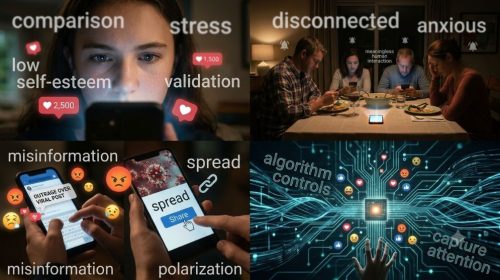
It is hardly surprising that psychologists have linked excessive social media use with rising levels of anxiety, stress and low self-esteem, particularly among adolescents and young adults. Constant comparison with carefully curated online identities creates unrealistic expectations about appearance, relationships, careers and personal success. The pursuit of digital validation—measured in likes, shares and followers—can become an unhealthy substitute for genuine self-worth.
Equally concerning is the erosion of meaningful human interaction.
Ironically, while social media connects billions of people digitally, it often disconnects them emotionally. Family dinners are interrupted by notifications. Friends sitting together frequently spend more time looking at their phones than speaking to one another. Holidays, celebrations and even acts of kindness are increasingly judged by how they appear online rather than by the experiences themselves.
Relationships suffer when virtual engagement replaces genuine conversation.
Privacy, too, has become a casualty of the digital age. Every photograph uploaded, every location shared and every search conducted contributes to an ever-expanding digital footprint. Many users disclose intimate details of their lives without recognising that personal information has become one of the world’s most valuable commercial assets. What is shared casually today may remain searchable for years to come.
Beyond individual lives, the content circulating on social media increasingly shapes society itself. Elections, public health campaigns and national debates are now influenced by online narratives that spread within minutes. While social media has empowered citizens to expose corruption, organise humanitarian efforts and hold institutions accountable, it has also become fertile ground for misinformation, conspiracy theories and organised disinformation campaigns.
The danger lies not only in false information but in the speed at which it spreads. Corrections rarely attract the same attention as the original falsehood. By the time the truth emerges, public opinion may already have shifted.
None of this means social media should be viewed solely through the lens of criticism. These platforms have created unprecedented opportunities. Small businesses can reach global customers without enormous marketing budgets. Students can access world-class educational resources. Professionals can build international networks. Communities can mobilise rapidly during emergencies and charitable causes can receive support within hours.
The greatest strength of social media lies in its ability to connect people instantly. It allows families separated by continents to remain close, enables professionals to build networks and offers students access to educational resources beyond traditional classrooms. During natural disasters, public health emergencies or humanitarian crises, social media often becomes the fastest channel for disseminating vital information. It has also given ordinary citizens a voice, allowing them to highlight social injustices, raise awareness and mobilise support for important causes.
These benefits are real and should not be overlooked.
However, the responsibility for ensuring that social media enriches rather than diminishes personal life cannot rest solely with technology companies. Governments have a legitimate role in promoting transparency and protecting users from harmful practices without undermining freedom of expression. Educational institutions should place far greater emphasis on digital literacy, teaching students not only how to use technology but how to evaluate information critically. Parents, too, must encourage healthy online habits by promoting balance, open discussion and responsible digital behaviour.
Ultimately, the greatest responsibility lies with individual users.
Every person should pause before sharing unverified information, recognise that online popularity is not a measure of personal value and remember that algorithms are designed to capture attention rather than promote wisdom. The ability to disconnect, engage in face-to-face conversation and think critically has become as important as the ability to connect online.
Technology has transformed the world with extraordinary speed. Social media is now too deeply embedded in modern life to be abandoned, nor should it be. Yet we must resist allowing algorithms to dictate our emotions, our opinions and our relationships.
The content we choose to consume every day quietly shapes our attitudes, our decisions and our character. In the end, protecting our personal lives in the digital age depends not only on better technology or stronger regulation, but on better judgement. We must remain in control of our screens, rather than allowing our screens to take control of us.