









Civil society organisations have called for a clear roadmap to protect human rights from the growing impacts of climate change in Bangladesh, stressing stronger institutional coordination, systematic monitoring and evidence-based policy action.
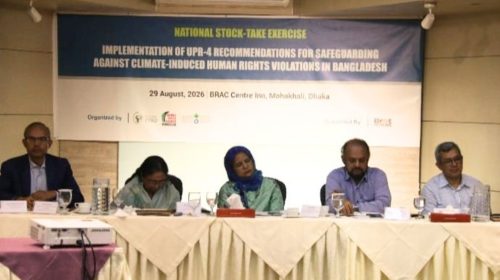
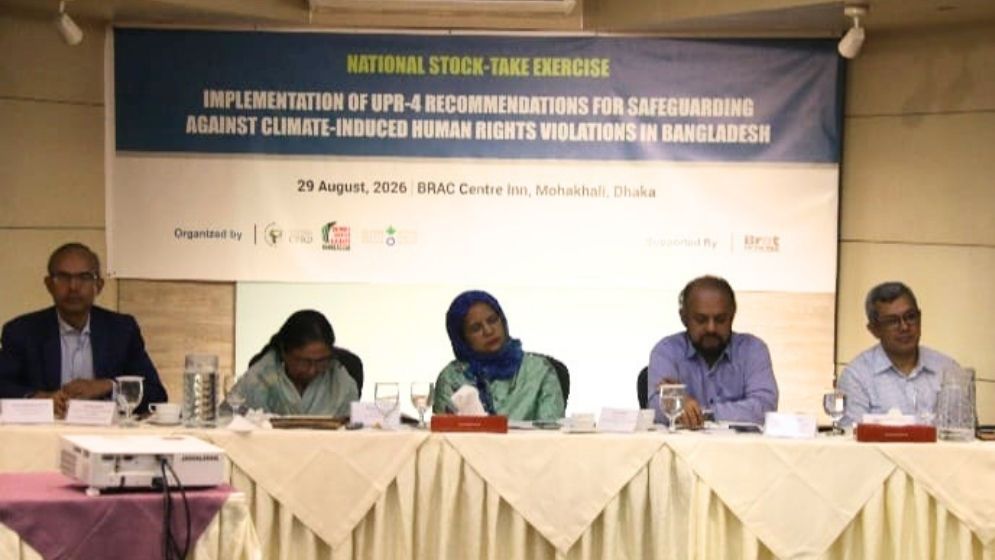
The call came at a national advocacy seminar titled “Stock-Take Exercise on the Implementation of UPR-4 Recommendations for Safeguarding Against Climate-Induced Human Rights Violations in Bangladesh” held at BRAC Centre Inn in Dhaka on Saturday.
The Center for Participatory Research and Development (CPRD), Action Against Hunger (ACF) and the Climate Justice Alliance-Bangladesh jointly organised the event, bringing together policymakers, human rights defenders, climate experts, academics, researchers and civil society representatives.
The seminar reviewed Bangladesh’s progress in implementing climate-related recommendations accepted by the government under the fourth cycle of the Universal Periodic Review (UPR) and identified gaps requiring further action.
Participants also formed a civil society platform and developed an action plan focusing on evidence generation, monitoring and advocacy to strengthen safeguards against climate-induced human rights violations.
12 recommendations accepted
In his opening remarks, CPRD Chief Executive and National Coordinator of the Climate Justice Alliance-Bangladesh Md Shamsuddoha said Bangladesh had supported two climate-related recommendations during the third UPR cycle in 2018 to address and mitigate the adverse impacts of climate change.
Building on those commitments, a coalition of 15 civil society organisations led by CPRD made a joint submission during the fourth UPR cycle in 2023.
The submission documented evidence of climate-induced human rights violations and proposed strategic actions across seven thematic areas.
The government subsequently accepted 12 recommendations for implementation during 2024-2027.
“We have the responsibility to follow up on how far these pledges have been translated into policies, programmes and actions, and to identify pathways to address the gaps,” Shamsuddoha said.
Climate change worsening rights violations
Dr Nurun Nahar, additional secretary at the Ministry of Environment, Forest and Climate Change, said climate change was increasingly contributing to human rights violations in Bangladesh, with climate-vulnerable and frontline communities bearing the greatest burden.
She said international climate negotiations had yet to adequately institutionalise mechanisms to address climate-induced human rights violations.
“This remains a major concern for us,” she said.
The keynote presentation by Sheikh Nur Ataya Rabbi, programme manager for research and advocacy at CPRD, presented evidence of climate-induced human rights violations documented since the third UPR cycle.
It also outlined civil society recommendations submitted during the fourth UPR cycle and assessed progress in implementing them.
Call for stronger institutions and monitoring
Former additional secretary of the Department of Environment and former deputy managing director of PKSF Dr Fazle Rabbi Sadek Ahmed stressed the need for stronger institutional coordination, systematic monitoring and evidence generation.
He also called for sustained policy advocacy to ensure that commitments made under the UPR process translate into effective measures on the ground.
Shaheen Anam, MBE, executive director of Manusher Jonno Foundation, appreciated CPRD and its partners for leading the initiative and urged continued efforts to protect climate-vulnerable and frontline communities.
She emphasised stronger collaboration among human rights defenders, climate experts, academics and civil society organisations.
Former additional director general of the Department of Environment Md Ziaul Haque said the government was concerned about climate-induced violations but needed to significantly strengthen institutional capacity to ensure adequate safeguards.
He also called for greater support from the international community and civil society organisations.
An expert panel discussion was held as part of the seminar, bringing together policymakers, human rights experts and defenders, climate specialists, academics, researchers and civil society representatives.
The discussion focused on implementation gaps, institutional responsibilities, evidence generation, and policy and advocacy pathways to ensure that Bangladesh’s UPR commitments translate into tangible protection for communities facing the growing human rights consequences of climate change.