
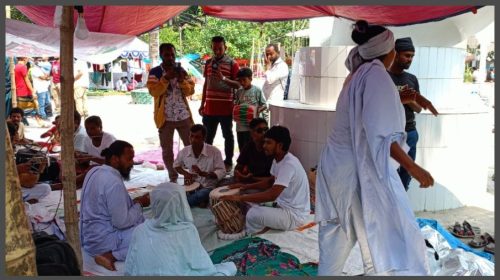











Lalon’s message of humanity, his rejection of caste and social discrimination, and the timeless appeal of his songs are drawing thousands of devotees, researchers and visitors to Cheuria in Kushtia for a three-day observance of his death anniversary.
People from across Bangladesh and beyond have gathered at Lalon Akharbari to celebrate the mystic’s enduring philosophy and reflect on its relevance in a world still divided by prejudice and intolerance.
For several days, the shrine has been alive with music, conversation and the steady arrival of visitors. Some carry books, others walk with an ektara slung over their shoulders, while many quietly sing Lalon’s songs. As evening falls, Baul melodies fill the air, including the familiar question: “Everyone asks what caste Lalon belongs to in this world.”
The song captures the spirit of the gathering. For many visitors, coming to Cheuria is about more than music or celebration. It is an opportunity to revisit Lalon’s teachings and consider what they mean for their own lives.
His appeal, they say, lies in his ability to challenge religious and social divisions while speaking about profound truths in the simple, everyday language of ordinary people. More than a century after his death, his message of human dignity and equality remains relevant—and perhaps even more urgent amid growing intolerance.
Karshed Alam, general secretary of Sammilita Andolon, said Lalon’s greatness went far beyond his music.
“Lalon did not merely write or sing songs. The most important lesson in his songs is that we should see every human being simply as a human being,” he said. “Being here makes you feel that, before religion, ethnicity or identity, we are all human.”
Fakir Arefin Uddin, a Lalon researcher who travelled from Gazipur, near Dhaka, believes the language of the songs is central to their lasting popularity.
“Lalon did not express philosophical ideas in difficult language. Using the everyday speech of rural people and familiar words, he conveyed profound truths about life,” he said. “That is why, when we listen to his songs, we feel they are speaking about us and our own lives.”
The gathering has also attracted foreign visitors. Some have come to conduct research, while others return to Cheuria because they feel drawn to Lalon’s philosophy. For them, he is not simply a Baul mystic but a thinker whose ideas offer a way of understanding life and human relationships.
Researcher S S Rushdi, who has studied Lalon for many years, said reducing him to the status of a Baul singer would overlook the depth of his thought.
“At the heart of his philosophy was the human being. He questioned human identity, divisions based on caste and social inequality. Those questions remain relevant to our society today,” he said.
The interest is not confined to older devotees and researchers. Near one corner of the shrine, groups of young people can be seen discussing Lalon’s songs, searching for lyrics on their mobile phones and recording performances.
Zahir Uddin Askari welcomed the younger generation’s interest but said more needed to be done to bring Lalon’s ideas closer to them.
“Holding events alone is not enough to bring Lalon’s philosophy to the new generation. His songs and ideas must be presented to young people in an accessible way,” he said.
For many at the shrine, Lalon’s rejection of caste and social hierarchy remains one of his most powerful messages. They believe his songs will continue to resonate as long as people judge one another by religion, ethnicity, social status or inherited identity.
Majeda Akhtar, a Baul singer from Chuadanga associated with a local akhara, said Lalon challenged the habit of judging people by outward identities.
“We often judge people by their religion, ethnicity, caste or social standing. Lalon challenged this way of judging others. His songs remind us that the greatest identity of all is being human,” she said.
Baul singer Madhu Shah has travelled from Mymensingh to attend the observance. For him, the journey to Cheuria is as much spiritual as it is musical.
“Every time I come here, I experience something new. Thousands of people gather in one place to listen to Lalon’s songs and speak about his teachings. This coming together, I feel, is Lalon’s greatest lesson,” he said.
Beyond the conversations about philosophy, the three-day observance has brought a festive mood to Cheuria. Stalls have sprung up around the shrine, while music and discussions continue throughout the day. As night falls, Baul gatherings grow livelier, with the sounds of the ektara, dotara and singers carrying across the grounds.
Yet beneath the festivities lies a shared purpose. Visitors have come not simply to remember a mystic but to reconnect with a vision of society in which human dignity comes before caste, religion and social divisions.
That vision continues to give Lalon’s songs their enduring power. His questions about identity and the person within remain unanswered, inviting each generation to reflect on what it means to be human.
And when the three-day gathering ends, his songs will continue to travel far beyond the shrine. Somewhere, a Baul will take up an ektara and sing those familiar lines again, keeping alive the questions that bring people back to Lalon, time and again.


