








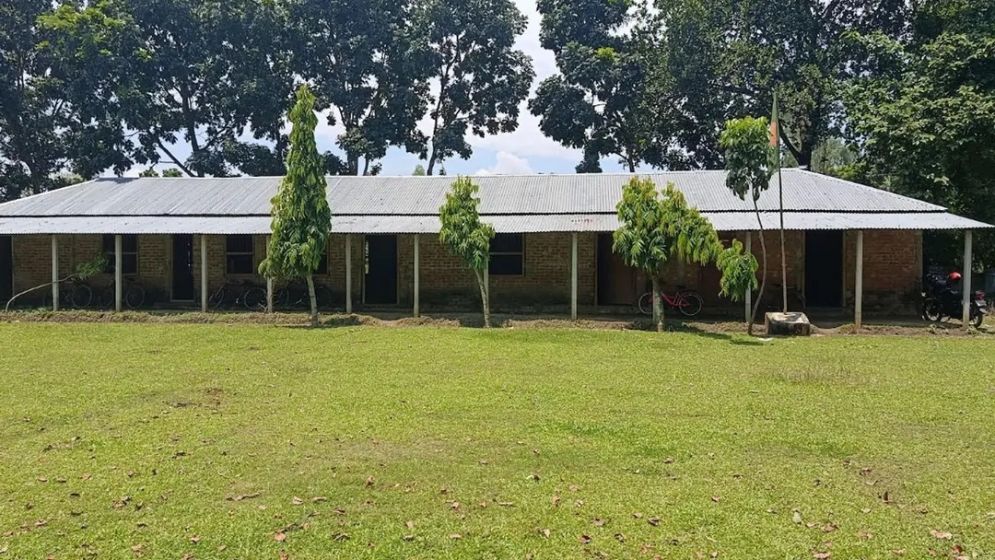

This year, 18 schools under Dinajpur Education Board recorded zero pass rate in the Secondary School Certificate (SSC) examinations, which means not a single candidate from those institutions passed in the exams.
The schools are spread across eight districts in northern districts, including Dinajpur, Rangpur, Gaibandha, Nilphamari, Kurigram, Lalmonirhat, Thakurgaon and Panchagarh.
But the figures point to something larger than examination failure. They raise questions about whether some rural schools are functioning as schools at all.
A sharp fall across the board
The Dinajpur board’s overall SSC pass rate fell to 58.05% this year, from 67.03% a year earlier–a decline of almost 9%.
Of the 180,752 students who sat the examination, 104,925 passed. Nearly 79,000 failed, while another 2,941 students were absent.
Professor Ilias Ahmed, chairman of the Dinajpur Education Board, said the reasons for the decline would become clearer after a formal review.
He also noted that results had fallen in most education boards across Bangladesh this year.
But the 18 schools with no successful candidates have prompted particular concern, and the board has promised investigations.
Schools without students, teachers
Visits to two of the schools in Panchagarh’s Boda upazila suggest that the problem extends far beyond classroom teaching.
At Balarampur Model Girls’ High School, established in 1998, only about 10 students were present during a midday visit, despite an enrolment of around 100.
Only three of the school’s 10 listed teachers, including the headteacher, were found on the premises.
There was another striking detail: there was no signboard identifying the building as a school.
Local residents alleged that classes were held irregularly and that the institution was being kept open largely in the hope of obtaining government recognition under the Monthly Pay Order (MPO) system.
MPO status is important for private educational institutions in Bangladesh because it provides government-funded salaries and other support.
At Boda Sardarpara Girls’ High School, the situation appeared even more serious.
There was no signboard. A single room was locked, while an adjoining tin-roofed structure had been stripped of doors, windows and fencing. Local education officials acknowledged that they had little reliable information about the school’s day-to-day activities.
The problem is not limited to one district
In Nilphamari’s Domar upazila, Ambari Girls’ High School had another grim result: all of its SSC candidates failed.
The school’s junior secondary section received formal government recognition in 2000. It has classrooms, buildings and publicly funded infrastructure.
Yet only about 20 to 30 of its 155 enrolled students reportedly attend classes on a typical day.
A teacher cited several interconnected problems: irregular attendance, parents’ lack of awareness, child marriage and a shortage of teachers.
These are familiar challenges in rural area in the country.
But when they occur together alongside weak monitoring and poor institutional accountability, they can turn a school into little more than a name on paper.
Where supervision works, students succeed
There is, however, another story from the same region.
At Ahchania Mission Shishu Nagari, a residential home for orphaned and abandoned children in Panchagarh, nine boys passed this year’s SSC examinations through Panchagarh Government Technical School and College.
Some had been separated from their families when they were as young as six. Others had lost a parent.
Yet they succeeded where many students in better-supported institutions did not.
The centre’s manager, Deepak Kumar Roy, said 48 children from the home have sat for the SSC examination over the past five years, with several achieving strong results.
He attributed the performance to regular supervision, communication with schoolteachers and strict limits on smartphone use.
The home, founded in 2012, now cares for around 160 children.
The contrast is striking.
Children without conventional family support are succeeding because someone is monitoring whether they attend school, study and remain on track.
Meanwhile, some schools with buildings, teachers and government recognition are failing to produce even one successful SSC candidate.
What happens next?
The Dinajpur board’s investigation into the 18 zero-pass schools will be an important test of whether the authorities are prepared to confront the deeper problems.
A serious review should establish more than why students failed their examinations.
It should ask if the schools had been functioning regularly, were the teachers and the students attending, were classes actually being held and were education authorities monitoring the activities of the schools?
Schools that exist largely on paper need immediate verification. Teacher attendance should be monitored through regular, unannounced inspections. Persistent absenteeism should have consequences.
Where child marriage, poverty and parental disengagement are driving students away from classrooms, intervention must extend beyond the school gates through community outreach, financial support and enforcement of existing laws.
The apparent success of supervised residential education also offers lessons. Regular attendance monitoring, close coordination between schools and caregivers, and controlled use of mobile phones are not expensive reforms, but they require consistent implementation.
And if the government’s MPO system is encouraging poorly functioning institutions to remain open in the hope of securing funding, the process itself may need closer scrutiny.
A warning for rural Bangladesh
The 18 schools with zero pass rates are not simply a statistic in this year’s SSC results.
They are a warning about the quality of education available to children in parts of rural northern Bangladesh.
A school can have a building, a registration number and a list of teachers. But none of those guarantees that children are actually being taught.
The Dinajpur Board’s falling results should therefore prompt a much broader question than the reasons for the students’ failure. The more fundamental question might be: How many rural schools are functioning properly?
Until that question is answered, this year’s record may prove to be more than a temporary decline. It could become the new baseline.